place

Linden Heights Historic District

Des Moines, Iowa stubsHistoric districts in Des Moines, IowaHistoric districts on the National Register of Historic Places in IowaHouses in Des Moines, IowaHouses on the National Register of Historic Places in Iowa
NRHP infobox with nocatNational Register of Historic Places in Des Moines, IowaPolk County, Iowa Registered Historic Place stubs
The Linden Heights Historic District

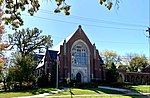
The Linden Heights Historic District is located on the west side Des Moines, Iowa, United States. The district exemplifies the residential styles that were popular in Des Moines from 1912 to 1956. It was also significant in the development of the western part of the city south of Grand Avenue, which is a major east–west thoroughfare. It has been listed on the National Register of Historic Places since 2003.

Excerpt from the Wikipedia article Linden Heights Historic District (License: CC BY-SA 3.0, Authors, Images).

Linden Heights Historic District
Parkhill Drive, Des Moines

Geographical coordinates (GPS) Address Nearby Places
placeShow on map

Wikipedia: Linden Heights Historic DistrictContinue reading on Wikipedia

Geographical coordinates (GPS)

Latitude Longitude
N 41.573611111111 ° E -93.676388888889 °
placeShow on map

Address

Parkhill Drive 4224
50312 Des Moines
Iowa, United States
mapOpen on Google Maps

The Linden Heights Historic District
Share experience

Nearby Places

Byron and Ivan Boyd House

The Byron and Ivan Boyd House, also known as Boyd Cottage, is a historic building located in Des Moines, Iowa, United States. Built in 1924, the 2½-story Tudor Revival half-timbered cottage is located in an up-scale neighborhood. The neighborhood is composed of large private residential lots with numerous mansions built in the first half of the 20th century for the city's prominent citizens. Its significance is its association with Byron Bennett Boyd. He was a local architect, and a nationally recognized artist and painter. Boyd was the architect that designed this house, and lived here from 1924 to 1945. He began practicing architecture at the prominent Des Moines firm of Proudfoot, Bird and Rawson before setting up his own practice in 1916 with Herbert Moore. His work includes Salisbury House (1923) and the Ralph Rollins House (1926). Boyd's wife, Ivan Bloom Hardin, owned her own publishing company. In his art career, Boyd was a contributor at the Stone City Art Colony, and was friends with Grant Wood and Thomas Hart Benton. He exhibited paintings at the Whitney Museum and the Metropolitan Museum of Art in New York City, the Corcoran Gallery of Art in Washington, D.C., the Pennsylvania Academy of Fine Arts in Philadelphia, the Art Institute of Chicago, and others. The house was listed on the National Register of Historic Places in 2004. It shares the historic designation with the limestone wall that extends around the perimeter of the grounds (contributing structure) and the stone patio and bench (contributing object).

Greenwood Park Plats Historic District

The Greenwood Park Plats Historic District is a nationally recognized historic district located in Des Moines, Iowa, United States. It was listed on the National Register of Historic Places in 2013. At the time of its nomination the district consisted of 393 resources, including 277 contributing buildings, one contributing site, 109 non-contributing buildings, and six non-contributing structures. Most of this district was originally known as Brown's Park, a private park that was the location of the Iowa State Fair from 1879 to 1885. Founded privately in 1854, the fair was held in several locations in the state making it more of a regional event. It was also not profitable. That changed when the fair moved to this location, and its profitability eventually led to funding from the Iowa General Assembly and a permanent location on the east side of the city. Brown's Park continued for a while longer and the streetcar line from Des Moines opened in 1889. The historic district is the northwest section of a former suburb known as Greenwood Park. It was incorporated as a city in the area of Brown's Park in 1881, and in 1890 it was annexed into the city of Des Moines. The Greenwood Park Association bought Brown's Park 1892. While it was platted for residential development, housing was not built here until 1910 and into the 1920s. For the most part, it continued to be used as a park until then. The part of the district north of Ingersoll Avenue is exclusively residential. Apartment buildings were built in the Greenwood Park Plat from 1918 to 1926, and five of them remain. Three churches were built in the district between 1922 and 1938. They include St. Augustine Catholic Church (1922), Plymouth Congregational Church (1926; now United Church of Christ), and Central Presbyterian Church (1938). Four medical buildings and an office building were built along 39th Street and on Ingersoll Avenue between 1955 and 1961. Prior to this, there was virtually no commercial development in Greenwood Park. Five more were completed between 1963 and 1975.