place

Market Street, George Town

Ethnic enclaves in MalaysiaLittle IndiasRoads in Penang
LITTLE INDIA GEORGETOWN PENANG ISLAND MALAYSIA JAN 2012 (7189858542)

Market Street is a street in the city of George Town in Penang, Malaysia. Located within the city's UNESCO World Heritage Site, this street was named after a market which was established by Indian emigrants to Penang. The street is known in Tamil as Kadai Teru, meaning "street of shops". The market continued to function even after the full reclamation that created Victoria Street. The area has been settled by south Indians, whose presence is still conspicuous till today. This part of town is now regarded as part of the Little India enclave in George Town. The street bears many similarities to market streets in Chennai, Mumbai or Delhi. It is a notable shopping spot among locals and tourists. This street is also famous for Malaysian Indian cuisine.

Excerpt from the Wikipedia article Market Street, George Town (License: CC BY-SA 3.0, Authors, Images).

Market Street, George Town

Geographical coordinates (GPS) Address Nearby Places
placeShow on map

Wikipedia: Market Street, George TownContinue reading on Wikipedia

Geographical coordinates (GPS)

Latitude Longitude
N 5.4177416666667 ° E 100.33855555556 °
placeShow on map

Address

Lebuh Pasar

Market Street
10200 George Town
Penang, Malaysia
mapOpen on Google Maps

LITTLE INDIA GEORGETOWN PENANG ISLAND MALAYSIA JAN 2012 (7189858542)
Share experience

Nearby Places

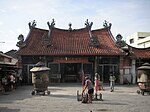
Penang Chinese Town Hall

The Penang Chinese Town Hall was established in 1881. Chung Keng Quee was the single largest individual donor towards the founding of the town hall and was a prominent president serving from 1881 to 1883.The main donors for the inauguration of the Penang Chinese Town Hall were the British Colonial Office (10,000 yuan), the Fukien Association (2,000 yuan), Ch'ao-chou Prefecture (1,800 yuan), Ch'iu Lineage Association (1,000 yuan), Hsieh Lineage Association (800 yuan), Cheng Ssu-wen (the fancy name of Chung Keng Quee) (600 yuan), and the Yang Clan of Ying-yuan kung (500 yuan). Two hundred and seventeen more donors contributed between 480 yuan to 10 yuan; a total of about 26,000 yuan was collected.In June 1905, Chinese merchants in Penang gathered in the Penang Chinese Town Hall, in support of the boycott on American goods, joining Singapore and China in putting pressure on the American government to improve its immigration policy towards the Chinese.In the election of the office bearer on 9 September 1906, Leong Lok Hing was made General President, Foo Choo Choon, Cheah Meng Chi, Chung Thye Phin and Lim Kek Chuan were made President, and Ng See Sin, Oon Boon Tan, Khaw Joo Tok, Quah Beng, Ong Hun Chong, Koh Leap Teng and Gnoh Lean Tuck were elected Vice President.On 22 June 2008 Penang Chinese Town Hall chairman, Tan Sri Lim Gait Tong said it was relevant to set up a special committee to establish the actual date it was founded because their records showed conflicting years in which the organisation was set up. He said that although the organisation's constitution stated that it was established in 1875, certain members had claimed that it was set up in 1881 and 1883.

Kapitan Keling Mosque

The Kapitan Keling Mosque (Malay: Masjid Kapitan Keling, Tamil: காப்பித்தான் கெலிங மசூதி, romanized: Kāppittāṉ Keliṅa Macūti) is a mosque built in the 19th century by Indian Muslim traders in George Town, Penang, Malaysia. It is situated on the corner of Buckingham Street (Lebuh Buckingham) and Pitt Street (Jalan Masjid Kapitan Keling). Being a prominent Islamic historic centre, it is part of the World Heritage Site of George Town and lies at the centre of the city's Tamil Muslim neighbourhood, the chulias. It is the first permanent Muslim institution to have been established in the area, dating from the early 1800s. Cauder Mohuddeen Merican is known as the founder of the mosque and leader of the Chulias. In 1801 Sir George Leith, who was then Lieutenant Governor of Penang, appointed a prominent Indian Muslim leader, Cauder Mohudeen, as Captain of the South Indian “Keling” community. He granted a piece of land to build a mosque on the south side of Malabar Street (Chulia Street). Cauder Mohudeen (born c. 1759) was a ship mandoor or foreman from Porto Novo, which the Tamils called Paringgipettai and the Muslims Mahmudbandar, about 50 kilometres south of Pondicherry in India. He was referred to as 'Kapitan Kling'."Keling" is a Malay term for people of Indian origin, nowadays considered offensive but not so considered at the time when the mosque was built. The "Kapitan " was a representative of the Indian community, like the "Kapitan Cina" for the Chinese community. Another renovation in 1930 gave the Kapitan Keling Mosque its present appearance after the previous design was deemed impractical. In keeping with tradition, the mosque was not rebuilt, but only enlarged. Among the major work during this period included doubling the height of the central prayer hall, improvement to the ventilation system, and allowing more natural light to enter. The exterior is ochre yellowed while the interior had white marble floors and a high ceiling. The interior aisles are formed by a series of horseshoe arches, crowned with King Edward's plaques. The façade of the building and its interior were decorated with geometric designs, as human and animal forms are forbidden in Islam.