place

Federal Reserve Bank Building (Little Rock, Arkansas)

Buildings and structures in Little Rock, ArkansasGovernment buildings completed in 1924Government buildings on the National Register of Historic Places in ArkansasLittle Rock, Arkansas Registered Historic Place stubsLittle Rock, Arkansas stubs
National Register of Historic Places in Little Rock, ArkansasNeoclassical architecture in Arkansas
Federal Reserve Bank Building, Little Rock, AR

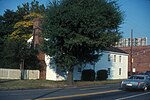
The Federal Reserve Bank Building is a historic commercial building at 123 West Third Street in Little Rock, Arkansas. It is a three-story Classical Revival masonry structure, built out of concrete faced with limestone. Its main facade features a central entry set in a recess supported by four monumental engaged Doric columns. The entrance surround includes a carved eagle. Above the colonnade is a band of metal casement windows, with a low parapet at the top. The building was designed by noted local architect Thompson & Harding and built in 1924. The building was occupied by the Federal Reserve Bank of St. Louis Little Rock Branch until 1966.The building was listed on the National Register of Historic Places in 1986.

Excerpt from the Wikipedia article Federal Reserve Bank Building (Little Rock, Arkansas) (License: CC BY-SA 3.0, Authors, Images).

Federal Reserve Bank Building (Little Rock, Arkansas)
Main Street, Little Rock

Geographical coordinates (GPS) Address Nearby Places
placeShow on map

Wikipedia: Federal Reserve Bank Building (Little Rock, Arkansas)Continue reading on Wikipedia

Geographical coordinates (GPS)

Latitude Longitude
N 34.745833333333 ° E -92.270833333333 °
placeShow on map

Address

Taylor Building

Main Street 304
72206 Little Rock
Arkansas, United States
mapOpen on Google Maps

Federal Reserve Bank Building, Little Rock, AR
Share experience

Nearby Places

Rose Building (Little Rock, Arkansas)

The Rose Building is a historic commercial building at 307 Main Street in Little Rock, Arkansas. It was built in 1900 from the plans of George R. Mann, and is named for Arkansas Supreme Court Chief Justice U. M. Rose. It is a prominent local example of commercial Classical Revival architecture. The building was built originally as an office property and by the early to mid twentieth century housed retail when the city's Main Street was the major shopping district. Rose purchased three lots on the Peyton Block of Main Street by 1880. Judge Rose built two preexisting Rose Buildings, both destroyed by fire on the current location. The existing structure is a 1916 incarnation of the Rose Building built by Rose's son. It is vastly different from the previous two structures. The two-story structure now displays a symmetrically massed Neoclassical façade, designed by George R. Mann. Mann was the architect who designed the existing Arkansas State Capitol and the Mann on Main mentioned above. It was later home to retail users in the mid twentieth century, two long term tenants were Allsopp-Chappell, a local bookstore, and Moses Melody shop. It had a myriad of occupants by the later part of the century, one being Gold's House of Fashions, in which the structure underwent a renovation. It was added to the National Register of Historic Places in 1986.The building is currently owned by a private investment group, which acquired it in 2002. It has been redeveloped by the national CRE investments and development organization, The Lasiter Group, the asset's owner. The 20,000 square foot building is fully redeveloped. The overall project encompasses both commercial and residential components, consisting of two restaurants in the building's ground floor, as well as 11 apartment units, consisting of 10 residential units upstairs and 1 ground floor unit.

Worthen Bank Building

The Worthen Bank Building is a historic commercial building at 401 Main Street in downtown Little Rock, Arkansas. It is a two-story masonry structure with neoclassical and Art Deco lines. It has a steel frame and is faced in limestone. Three bays of three-part windows stand on the second floor, and two flank the center entry. The building was constructed in 1928 for the Worthen Bank, founded in 1877 (later merged into St. Louis-based Boatmen's Bancshares, itself integrated into Bank of America), and was designed by George R. Mann, a prominent local architect otherwise known for his design of the Arkansas State Capitol. Annexes and a parking garage were added in 1952 and 1962, along with some modernization of the 1928 building. In 1969, the complex was acquired by local ABC television network affiliate KATV (channel 7), which converted it into studios, as Worthern relocated to a new skyscraper nearby; the complex then became the KATV Building, with the monicker applied on the facade of the 1954 annex and other details denoting the building's new use, including decorative iron grating in the entryway of the 1928 building formed in the station's Circle 7 logo.KATV vacated the Worthen complex in January 2023 for a newer building in the Riverdale section, as it had become too large and outdated for a modern television station and exterior maintenance had been deferred for years, even before the station's acquisition by Sinclair Broadcasting Group, which saw a modern and streamlined broadcast facility for the station as a priority. The 1928 portion of the building is expected to be restored to its original state, with the newer 1950s addition and attached parking garage to be torn down as part a new technology park development.The original 1928 building was listed on the National Register of Historic Places in 1986.

Historic Arkansas Museum

The Historic Arkansas Museum, sometimes called HAM, is a state history museum in downtown Little Rock, Arkansas. The museum was created as part of the Arkansas Territorial Capitol Restoration Commission, by Act 388 of the 1939 Arkansas General Assembly. The act named Louise Loughborough as chairwoman of the commission. Loughborough had been named to the Little Rock Planning Commission in 1935. Several houses near Cumberland and East 3rd Streets in downtown Little Rock were going to be condemned, including the Hinderliter House, the oldest building in Little Rock. Loughborough started a public relations campaign around Little Rock as a "town of three Capitols": the Hinderliter House, the Old State House, and the current Arkansas State Capitol Building. Use of the Hinderliter House as the last meeting place of the Arkansas Territorial Legislature has remained part of popular folklore, though it is not known if it was used for this purpose. Loughborough then gained support from the Works Progress Administration, the Arkansas General Assembly, and private donors. Loughborough worked with architect Max Mayer to restore the half-block of houses at Cumberland and East 3rd Street in downtown Little Rock. The Museum opened on July 19, 1941.The museum maintains gallery space and a number of historic buildings original to the site, as well as log structures transported from around the state. It was previously known as the Arkansas Territorial Restoration, but the name was changed in 2001 when new exhibit space and renovations were completed. The museum is an affiliate within the Smithsonian Affiliations program. The museum property was listed on the National Register of Historic Places in 2019 as the Arkansas Territorial Restoration Historic District.