place

Composite House for Terre Haute

2007 sculpturesBuildings and structures in Terre Haute, IndianaOutdoor sculptures in IndianaTourist attractions in Terre Haute, Indiana

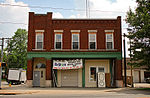
Composite House for Terre Haute is a public artwork by American artist Lauren Ewing, located in Gilbert Park at 14 1/2 Street and Wabash Ave. (U.S. Route 40) in Terre Haute, Indiana, United States. It is part of the Wabash Valley Art Spaces Outdoor Sculpture Collection.

Excerpt from the Wikipedia article Composite House for Terre Haute (License: CC BY-SA 3.0, Authors).

Composite House for Terre Haute
Wabash Avenue, Terre Haute

Geographical coordinates (GPS) Address Website Nearby Places
placeShow on map

Wikipedia: Composite House for Terre HauteContinue reading on Wikipedia

Geographical coordinates (GPS)

Latitude Longitude
N 39.46828 ° E -87.39361 °
placeShow on map

Address

Miller Parrott Lofts

Wabash Avenue 1450
47803 Terre Haute
Indiana, United States
mapOpen on Google Maps

Website
millerparrott.com

linkVisit website

Share experience

Nearby Places

Terminal Arcade
Terminal Arcade

The Terminal Arcade, located on Wabash Avenue in downtown Terre Haute, Indiana, is a Beaux-Arts building on the National Register of Historic Places since June 30, 1983. The building originally served as the Terre Haute, Indianapolis and Eastern Traction Company interurban station, opening in 1911. It was built on the grounds of the former J. S. Evans and Sons, a bicycle shop. The end of the interurban age came on January 11, 1940, when the track between Terre Haute and Indianapolis was closed, largely the result of automobiles making interurbans superfluous. From December 1, 1949, until 1972 the Arcade served as the city's union bus station.The Beaux-Arts building is made of terra cotta and brick. It has identical facades on its north and south sides, constructed of limestone and with granite bases. Various designs carved upon the building include lions, garlands, and fruits. The building itself was designed by Daniel H. Burnham of Chicago; the facades were the work of Fred Edler and J. W. Quayle.: Part 1, p. 26–27 The other property in Terre Haute built by the Terre Haute, Indianapolis, and Eastern Traction Company was a power house at the corner of Mulberry and North Water. It was built in 1907 to power the interurbans the Terminal Arcade served, and the 457 miles of track the interurban ran upon. The 1907 lease, under the name of the Terre Haute Traction & Light Company, called for 999 years; interurbans were no more by 1940.There have been threats to the Terminal Arcade. The mayor of Terre Haute Pete Chalos proposed condemning the building. In 2004, during talks for building a new federal building in Terre Haute, one of the proposals would have included razing the Terminal Arcade and placing the new building on its site.As of August 2022, a new pub is scheduled to operate in the space, it's scheduled to open by late January 2023.

Eugene V. Debs Home
Eugene V. Debs Home

The Eugene V. Debs House, on the campus of Indiana State University in Terre Haute, Indiana, was a home of union leader Eugene V. Debs. It was declared a National Historic Landmark in 1966. The museum is maintained by the Eugene V. Debs Foundation, a non-profit educational foundation. Eugene V. Debs and his wife, Kate, built the two-story frame house in 1890, after their fifth wedding anniversary. Debs was criticized for the house not portraying working-class lifestyle; his wife was a beneficiary of her wealthy aunt's will and could furnish the house affluently. Visitors to Debs' house during his lifetime included friends James Whitcomb Riley and Carl Sandburg; one room in the house to this day is known as the Riley bedroom. When Debs died in 1926, a funeral sermon was given for him at the house, attended by 5000 people.Original features of the house include the cobalt blue porcelain tile fireplace imported from Italy, the mahogany dining and parlor furniture, and the entire set of Haviland china. The house is also a museum, with many memorabilia of Debs' life and some of his personal library, much of which is across the street at the library of Indiana State University. One room is covered by murals depicting Debs' life.After Debs' death, the house would see different owners. One was a professor at Indiana State University. It was used as the Theta Chi fraternity house from 1948 to 1961, and briefly was let as apartments. In 1962, the home was bought by the Eugene V. Debs Foundation, which continues to own the house. In 1965, it was made an official Indiana historic site by the Indiana General Assembly. In 1966, the home was made an official National Historic Landmark of the National Parks system of the Department of the Interior [1]. In 2004, it was removed from threatened status after sufficient repairs to the structure occurred to ensure its permanence. Today, the preservation of the property is monitored by the National Park Service.