place

Teatro de Cristóbal Colón

Opera houses in ColombiaTheatres completed in 1892Theatres in BogotáTourist attractions in Bogotá
TeatroColonBogota
TeatroColonBogota

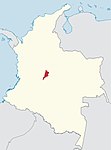
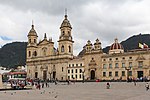
The Teatro de Cristóbal Colón (The Christopher Columbus Theatre), also known as the "Teatro Colón", is located in Bogotá, Colombia and it is the nation's National Theatre. It was built in the Neoclassical style by the Italian architect Pietro Cantini in 1885 and inaugurated on 27 October 1892. on the occasion of the fourth centenary of the discovery of America with a performance of Verdi's Ernani.The auditorium was constructed in the tradition horseshoe-shape and modelled on the layout of the Palais Garnier in Paris, but only about half the size.The Colón Theatre was declared a National Monument on 11 August 1975, and underwent renovations for three years.Between 2009 and 2010, the theatre was closed for extensive renovations.

Excerpt from the Wikipedia article Teatro de Cristóbal Colón (License: CC BY-SA 3.0, Authors, Images).

Teatro de Cristóbal Colón
Calle 10, Bogota UPZs Localidad La Candelaria

Geographical coordinates (GPS) Address External links Nearby Places
placeShow on map

Wikipedia: Teatro de Cristóbal ColónContinue reading on Wikipedia

Geographical coordinates (GPS)

Latitude Longitude
N 4.5966666666667 ° E -74.074444444444 °
placeShow on map

Address

Teatro Colón

Calle 10
111711 Bogota, UPZs Localidad La Candelaria
Colombia
mapOpen on Google Maps

linkWikiData (Q2518305)
linkOpenStreetMap (24457189)

TeatroColonBogota
TeatroColonBogota
Share experience

Nearby Places

Roman Catholic Archdiocese of Bogotá

The Metropolitan Archdiocese of Bogotá (Spanish: Arquidiócesis Metropolitana de Bogotá; Latin: Archidioecesis Metropolitae Bogotensis) is a particular church of the Roman Catholic Church in Colombia. It was established in 1562 as the Diocese of Santa Fe en Nueva Granada, elevated to an archdiocese two years later, and was given its current name in 1891. It serves nearly 3.8 million Catholics in Bogotá and parts of the Cundinamarca Department, and covers a total area of 4,109 km2 (1,552 square miles). The current metropolitan archbishop is Luis José Rueda Aparicio since 2020. The archdiocese is the metropolitan see of the Ecclesiastical Province of Bogotá, which includes six suffragan dioceses: Engativá Facatativá Fontibón Girardot Soacha ZipaquiráThe archdiocese's territory covers 14 of the 20 localities (administrative districts) of the city of Bogotá and 11 municipalities in the Cundinamarca Department. Prior to 2003, when three new urban dioceses were created, the archdiocese included all of Bogotá. The mother church of the archdiocese, and the seat of the archbishop, is the Cathedral-Basilica of the Immaculate Conception, located in Bolívar Square in Bogotá. Besides the archbishop, Luis José Rueda Aparicio, the archdiocese has two auxiliary bishops, Luis Manuel Alí Herrera and Pedro Manuel Salamanca Mantilla. The archdiocese is served by around 800 priests, 100 deacons, and nearly 1,500 religious sisters. The Archdiocese of Bogotá has 275 parishes, containing numerous churches. The archdiocese runs two seminaries, the Major Seminary of Bogotá, which enrolls seminarians from the Archdiocese of Bogotá and other dioceses, and the Seminario Intermisional San Luis Beltrán, which trains priests for ministry in Colombia's missionary territories. It also contains several universities, dozens of secondary schools and primary schools. The archdiocese also runs a spiritual retreat house, a care center for physically and mentally disabled children, and a migrant charity foundation, among other ministries.

Colegio Mayor de San Bartolomé

Colegio Mayor de San Bartolomé is a private Catholic pre-school, primary and secondary school, colonial of Plateresque style building, located in the Santa Fe district of Bogotá, Cundinamarca, Colombia. The co-educational school was founded on 27 September 1604 by the Archbishop of Bogota Bartolomé Lobo Guerrero and the Jesuits José Dadey, Martín de Funes, Juan Bautista Coluccini, Martín de Torres, Bernabé de Rojas, and Diego Sánchez. The school is managed by the Society of Jesus. Sometimes called the National College of San Bartolomé, the College of San Bartolomé, and the College of the Society of Jesus, the school is the oldest Colombian school in continuous operation, with a 400-year history since its founding in 1604. The Pontifical Xaverian University in the colony grew out of it in 1623. At St. Bartholomew, in 1826, the Central University of the Republic was founded, predecessor of the National University of Colombia, which brought together the National Library of Colombia, the College of San Bartolomé, and the university itself. It has been administered sometimes by the State and sometimes by the Jesuits, in whose hands it is today. Colegio Mayor de San Bartolomé, with its more than 412 years of existence, made a very significant contribution to Colombian society in the independence epoch. Many of its students and alumni played a key role in the emancipation process; it has generated real social mobility due to the preparation it gives its students. Twenty eight presidents of Colombia have graduated from the school, among other figures of national importance. In 2016 the school had approximately 1500 students. Its baccalaureate building is a cultural and national monument by Decree 1584 of 11 August 1975, and is located diagonally across from the southeast corner of Bolivar Square in Bogota. This building along with the Church of St.Ignatius and the Museum of Colonial Art in Bogota are part of the Jesuit block, which has been under restoration by the Society of Jesus and the Colombian Ministry of Culture.

Luis Ángel Arango Library

Luis Ángel Arango Library (Biblioteca Luis Ángel Arango or BLAA) is a public library located in Bogotá, Colombia. It is one of the largest and most important libraries in the world. It was founded in 1958 as a small library with a few books on economics, currently its collection has about 2'000.000 works. Today the library has been expanded and occupies two entire city blocks spanning about 45,000m² (nearly 54,000 sq. yards). Its collection has grown to become the country's premier library and has come to be considered the most important public library in Latin America, and one of the most visited in the world. It has over 1.1 million books and seating for 1900 readers; it received 6.7 million visitors in 2008. The library is named after the lawyer and businessman Luis Angel Arango, the general director (Governor) of the "Banco de la Republica" in Colombia from 1947 to 1957, and a champion of culture and literature for all. The library is part of the cultural affairs wing of Colombian Central Bank (Banco de la República), Banrepcultural network, which today runs 23 additional libraries, cultural centers and museums across Colombia. Notable Books and documents of its collection include, multimedia documentary materials of the Colombian Constitution, rare books and manuscripts purchased from private collections from around the world, as well as the Luis López de Mesa periodicals archive (Hemeroteca) which is an extensive newspaper archive collection. The Library also offers a collection of audio-visual materials. Additionally, there is a Concert Hall, art exhibits, reprography service, a cafeteria and parking facilities. It centralizes the "digital collection" and the "Virtual Library" (Biblioteca Virtual del Banco de la República) a growing repository of digitized content from the network of libraries of the Banco de la República. The Botero Museum is housed in one of the contiguous buildings purchased for the expansion of the library. The main entrance features a bronze statue of Athena or Minerva, Greek goddess of wisdom, the arts, trade and defense. There is also a bookstore in the first floor of the library. The bookstore specializes in books about Colombia, scientific magazines, and literature related to Colombia and its values.