place

Messick High School

1908 establishments in Tennessee1981 disestablishments in TennesseeBuildings and structures demolished in 1982Defunct schools in TennesseeDemolished buildings and structures in Tennessee
Educational institutions disestablished in 1981Educational institutions established in 1908High schools in Memphis, Tennessee

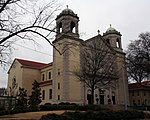
Messick High School was a public high school in Memphis, Tennessee, established in 1908 and operated from 1909 to 1981. The main building was demolished in 1982, but Memphis City Schools uses some other former Messick facilities to house the Messick Adult Education Center.Messick High School was built by Shelby County to consolidate three elementary schools. It was a full 12 grade school until 1912 when the high school grades 9-12 were moved to the new and nearby West Tennessee Normal School (Now U of M) to train teachers. After that Messick School included only elementary grades, but a high school building was added in the 1920s and all 12 school grades were enrolled as of 1924. At the time of its construction, the school was in a rural area of Shelby County called Buntyn, Tennessee, where truck farming was a major economic activity.The school was named for Elizabeth Messick (1876-1951), a University of Chicago graduate who was superintendent of Shelby County Schools from 1904 to 1908 and who had been criticized for spending $30,000 to build the new high school. Messick later married Memphis Commercial Appeal journalist Elmer E. Houck and used the name Elizabeth Messick Houck.In its rural location, some early students lived too far from the school to walk there, so they were transported to school in horse- or mule-drawn wagons. Initially, lunches were provided by students' mothers who brought hot meals to the school at mid-day. With time, Messick became the first school in West Tennessee to have a school cafeteria.Residential subdivisions grew up in the surrounding area in the 1920s. In the 1930s, Messick became part of the Memphis City Schools system. Much additional residential development occurred in the area in the late 1940s, after World War II ended. By the 1970s, however, the neighborhood was losing population and Messick's enrollment declined. In the 1970s, Messick high school also had kindergarten classes. The city school board voted to close the school. The graduating class of 1981 was Messick's last, and the school's main building was demolished in 1982.

Excerpt from the Wikipedia article Messick High School (License: CC BY-SA 3.0, Authors).

Messick High School
Carnes Avenue, Memphis

Geographical coordinates (GPS) Address Nearby Places
placeShow on map

Wikipedia: Messick High SchoolContinue reading on Wikipedia

Geographical coordinates (GPS)

Latitude Longitude
N 35.11184 ° E -89.95405 °
placeShow on map

Address

Carnes Avenue 3255
38111 Memphis
Tennessee, United States
mapOpen on Google Maps

Share experience

Nearby Places

Maxwelton
Maxwelton

Maxwelton is a historic single-story house in Memphis, Tennessee, that is listed on the National Register of Historic Places. It is the only extant example in Memphis of a Victorian piano box house. It is currently a private residence. The piano box house is a vernacular architectural style found in houses built in Middle and West Tennessee, from the mid-19th century into the early part of the 20th century. These one-story houses acquired the name "piano box" from their shape, which was seen to resemble that of a rectangular grand piano.Maxwelton was built around 1860 from Tennessee native Poplar and Cypress woods. It features a long recessed central porch between two flanking parlors. The interior of the home has 14-foot (4.3 m) ceilings. Its floors are made from 4-inch (100 mm) pine boards. There are five fireplaces with wooden mantels and some have ornately tiled hearths. It is named after a famed estate Maxwelton House home of Annie Laurie in Dumfriesshire, Scotland. Judge John Louis Taylor Sneed purchased the home in 1874. The home has been in the Sneed - Ewell family for four generations. Upon Judge Sneed's death, his wife inherited Maxwelton. Since the couple had no children, after her death the home was passed to her nephew, John Sneed Webb and then to Webb's daughter, Kathleen. In 1918 Kathleen was married in the home to Arthur Peyton Ewell and they had two sons, Arthur Webb Ewell and John Sneed Ewell, both of whom were born in Maxwelton's west bedroom. Maxwelton was placed on the National Register of Historic Places in 1980.

Pink Palace Museum and Planetarium

The Museum of Science & History - Pink Palace in Memphis, Tennessee, serves as the Mid-South's major science and historical museum and features exhibits ranging from archeology to chemistry. Over 240,000 people visit the museum each year.The museum is part of the Museum of Science & History - Memphis, a collection of historic, educational, and technological attractions maintained by the City of Memphis and Memphis Museums, Inc. The Lichterman Nature Center, the first accredited nature center in the United States, is part of the museum, as well as the Coon Creek Science Center, an education center which is open to organized groups and features a fossil site.The Mallory-Neely House and Magevney House are also part of the museum. The Mallory-Neely House is a three-story Italianate Victorian mansion built in 1852, and features 25 rooms and most of its original furnishings. The Magevney House, an 1830s cottage furnished as it might have been in 1850, is one of the city's oldest remaining residences. The AutoZone Dome at the Sharpe Planetarium, housed at the museum, features an 165-seat theater-in-the-round auditorium and offers public shows that project star fields, visual images, and laser lights on a domed ceiling. The Crew Training International 3D Giant Theater opened on January 21, 1995, and features a four-story high movable screen. The Museum of Science & History - Pink Palace, the Sharpe Planetarium, and the Crew Training International 3D Giant Theater are accredited members of the American Alliance of Museums.

Memphis, Tennessee
Memphis, Tennessee

Memphis is a city in the U.S. state of Tennessee. It is the seat of Shelby County, in the southwesternmost part of the state, and is situated along the Mississippi River. With a population of 633,104 at the 2020 U.S. census, Memphis is the second-most populous city in Tennessee after Nashville. Memphis is the fifth-most populous city in the Southeast, the nation's 28th-most populous overall, as well as the largest city bordering the Mississippi River and third largest metropolitan statistical area behind Greater St. Louis and the Twin Cities on the Mississippi River. The Memphis metropolitan area includes West Tennessee and the greater Mid-South region, which includes portions of neighboring Arkansas, Mississippi and the Missouri Bootheel. One of the more historic and culturally significant cities of the Southern United States, Memphis has a wide variety of landscapes and distinct neighborhoods. The first European explorer to visit the area of present-day Memphis was Spanish conquistador Hernando de Soto in 1541. The high Chickasaw Bluffs protecting the location from the waters of the Mississippi was contested by European settlers as Memphis developed. By 1819, when modern Memphis was founded, it was part of the United States territory. John Overton, James Winchester, and Andrew Jackson founded the city. Based on the wealth of cotton plantations and river traffic along the Mississippi, Memphis grew into one of the largest cities of the Antebellum South. After the Civil War and the end of slavery, the city continued to grow into the 20th century. It became among the largest world markets for cotton and lumber.Home to Tennessee's largest African-American population, Memphis played a prominent role in the American Civil Rights Movement. Leader Martin Luther King Jr. was assassinated there in 1968 after activities supporting a strike by the city's maintenance workers. The National Civil Rights Museum was established there and is a Smithsonian affiliate institution. Since the civil rights era, Memphis has become one of the nation's leading commercial centers in transportation and logistics. The largest employer is FedEx, which maintains its global air hub at Memphis International Airport. In 2021, Memphis was the world's second-busiest cargo airport. The International Port of Memphis also hosts the fifth-busiest inland water port in the U.S. The Globalization and World Cities Research Network considers Memphis a "Sufficiency" level global city as of 2020.Memphis is a center for media and entertainment, notably a historic music scene. With blues clubs on Beale Street originating the unique Memphis blues sound, the city has been nicknamed the "Home of the Blues". Its music has continued to be shaped by a multicultural mix of influences: country, rock and roll, soul, and hip-hop. The city is home to a major professional sports team, the Grizzlies of the NBA and the Memphis Showboats of the UFL. Other attractions include Graceland, the Memphis Pyramid, Sun Studio, the Blues Hall of Fame and Stax Museum of American Soul Music. Memphis-style barbecue has achieved international prominence, and the city hosts the annual World Championship Barbecue Cooking Contest, which attracts more than 100,000 visitors each year. Higher-level educational institutions include the University of Memphis, Christian Brothers University and Rhodes College.