place

Visvesvaraya Industrial and Technological Museum

1962 establishments in Mysore StateMuseums established in 1962Museums in BangaloreScience museums in IndiaUse Indian English from May 2018
Vitm
Vitm

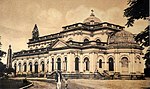
The Visvesvaraya Industrial and Technological Museum (VITM), Bangalore, India, a constituent unit of the National Council of Science Museums (NCSM), Ministry of Culture, Government of India, was established in memory of Bharat Ratna Sir M. Visvesvaraya. The building, with a built up area of 4,000 m2 (43,000 sq ft), was constructed in Cubbon Park. It houses various scientific experiments and engines, and was inaugurated by the first Prime Minister of India, Pandit Jawaharlal Nehru, on 14 July 1962. The first gallery set up at VITM, on the theme of 'Electricity', was opened to the public on 27 July 1965.

Excerpt from the Wikipedia article Visvesvaraya Industrial and Technological Museum (License: CC BY-SA 3.0, Authors, Images).

Visvesvaraya Industrial and Technological Museum
Kasturba Road, Bengaluru Sampangiram Nagar Ward (East Zone)

Geographical coordinates (GPS) Address Phone number Website External links Nearby Places
placeShow on map

Wikipedia: Visvesvaraya Industrial and Technological MuseumContinue reading on Wikipedia

Geographical coordinates (GPS)

Latitude Longitude
N 12.9751 ° E 77.5964 °
placeShow on map

Address

Viswesvariya Industrial and Technology Museum

Kasturba Road
560001 Bengaluru, Sampangiram Nagar Ward (East Zone)
Karnataka, India
mapOpen on Google Maps

Phone number

call+9108022866200

Website
vismuseum.gov.in

linkVisit website

linkWikiData (Q3537014)
linkOpenStreetMap (52032475)

Vitm
Vitm
Share experience

Nearby Places

Cubbon Park
Cubbon Park

Cubbon Park, officially known as Sri Chamarajendra Park, is a landmark 'lung' area of Bengaluru city, located (12.97°N 77.6°E / 12.97; 77.6) within the heart of the city in the Central Administrative Area. Originally created in 1870, when Major General Richard Sankey was the then British Chief Engineer of Mysore state, it covered an area of 100 acres (0.40 km2) and subsequent expansion has taken place and the area reported now is about 300 acres (1.2 km2). It has a rich recorded history of abundant flora and fauna plantations coupled with numerous impressive and aesthetically located buildings and statues of famous personages, in its precincts.This public park was first named as Meade’s Park after Sir John Meade, the acting Commissioner of Mysuru in 1870 and subsequently renamed as Cubbon Park after the longest-serving commissioner of the time, Sir Mark Cubbon. To commemorate the Silver Jubilee of Sri Krishnaraja Wodeyar’s rule in Mysore State, in 1927, the park was again renamed as Sri. Chamarajendra Park, in memory of the 19th-century ruler of the state Sri Chamarajendra Wodeyar (1868–94), during whose rule the park came into existence.The landscaping in the park creatively integrates natural rock outcrops with thickets of trees, massive bamboos, with grassy expanse and flowerbeds and the monuments within its limits, regulated by the Horticulture Department of the Government of Karnataka. The predominantly green area of the park has many motorable roads, and the well-laid-out walking paths running through the park are frequented by early morning walkers and the naturalists who study plants in the tranquil natural environment. Tourists visiting this park in the city of Bengaluru have nicknamed the city itself as 'Garden City'.The importance of the park to the city's environment is best stated by two urban architects who have won the national competition to design 'Freedom Park'.