place

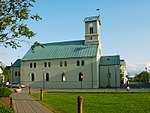
Fríkirkjan í Reykjavík

Churches completed in 1901Churches in ReykjavíkTourist attractions in Reykjavík
Iglesia Libre Reikiavik, Reikiavik, Distrito de la Capital, Islandia, 2014 08 13, DD 088

The Fríkirkjan í Reykjavík (Icelandic: The Free Church in Reykjavik) is a church which is apart from the State Church. It is an independent Lutheran Free Church of Iceland. It lies in the centre of the Icelandic capital, by the lake Tjörnin. The Fríkirkjan í Reykjavík congregation was established in Reykjavík in the autumn of 1899. It had an initial membership of 600 which soon rose. The foundation of the Free Church did not spring from any doctrinal dispute with the national Lutheran church, but arose from objections to certain aspects of the national church's organisations. The Free church followed the example of churches in Norway and those of Icelandic immigrant communities in North America, in wishing to bring the church closer to the people. The rising population of Reykjavík and the concomitant social changes also contributed. Craftsmen and tradesman were growing classes in the town, and new districts were built, and yet Reykjavík Cathedral was still the only church. Shortly after the new congregation was founded, a suitable site for a new church was chosen at the east of the lake. The church was consecrated on 22 February 1903. Only two years later the church was lengthened, to a design by architect Rögnvaldur Ólafsson. In 1924 the church was enlarged again. A chancel was built of concrete at the eastern end, and various alterations were built on either side of the forechurch, supervised by master builder Guðmundur H. Þorláksson. The pipe organ for Tim Hecker's album Ravedeath, 1972 was recorded at Fríkirkjan in July 2010.

Excerpt from the Wikipedia article Fríkirkjan í Reykjavík (License: CC BY-SA 3.0, Authors, Images).

Fríkirkjan í Reykjavík
Fríkirkjuvegur, Reykjavik Miðborg

Geographical coordinates (GPS) Address External links Nearby Places
placeShow on map

Wikipedia: Fríkirkjan í ReykjavíkContinue reading on Wikipedia

Geographical coordinates (GPS)

Latitude Longitude
N 64.144316666667 ° E -21.939230555556 °
placeShow on map

Address

Fríkirkjan í Reykjavík

Fríkirkjuvegur 5
101 Reykjavik, Miðborg
Iceland
mapOpen on Google Maps

linkWikiData (Q1250667)
linkOpenStreetMap (89661433)

Iglesia Libre Reikiavik, Reikiavik, Distrito de la Capital, Islandia, 2014 08 13, DD 088
Share experience

Nearby Places

Reykjavik Women's Gymnasium

Reykjavik Women's Gymnasium (Icelandic: Kvennaskólinn í Reykjavík) was the first secondary school for women in Iceland. It was begun in 1874 by Þóra Melsteð and Páll Melsteð, as a private school. For the first four years the school was located in the home of the founders near the Parliament Building in the center of Reykjavík. In 1909, it was moved to a new building at Fríkirkjuvegur and the primary offering became domestic science. The curriculum was later expanded to include liberal arts.Between 1911 and 1942, the school home economics department was one of its primary offerings, but that course was discontinued when the Húsmæðraskóli was built. In 1946 the school became part of the public education system of Iceland, admitting girls who had passed their primary school examinations. Completion of the school's four-year program conferred a certificate, which was usually called "Kvennaskólapróf". With the passage of the Primary School Act in 1977, the first boy was admitted and the school began offering coeducational curricula. Simultaneously, the school established a two-year division for a social services certificate and in 1979, a third study area, resulting in a University Entrance Examination certificate was added.Currently the school offers three academic focal areas: languages, natural sciences or social sciences. It is a three-year school offering general education equivalent to the US 11th and 12th grades of High School plus a two-year Junior college program, or the last three years of British grammar school plus the first year of university study. The degree awarded upon completion is now called a Stúdentspróf which is a Pre-University Entrance Examination equivalent.

Althing
Althing

The Alþingi (general meeting in Icelandic, [ˈalˌθiɲcɪ], anglicised as Althingi or Althing) is the supreme national parliament of Iceland. It is one of the oldest surviving parliaments in the world. The Althing was founded in 930 at Þingvellir ("thing fields" or "assembly fields"), situated approximately 45 kilometres (28 mi) east of what later became the country's capital, Reykjavík. Even after Iceland's union with Norway in 1262, the Althing still held its sessions at Þingvellir until 1800, when it was discontinued. It was restored in 1844 by royal decree and moved to Reykjavík. The restored unicameral legislature first came together in 1845 and after 1874 operated in two chambers with an additional third chamber taking on a greater role as the decades passed until 1991 when Althing became once again unicameral. The present parliament building, the Alþingishús, was built in 1881, made of hewn Icelandic stone. The unicameral parliament has 63 members, and is elected every four years based on party-list proportional representation. The current speaker of the Althing is Birgir Ármannsson. The constitution of Iceland provides for six electoral constituencies with the possibility of an increase to seven. The constituency boundaries and the number of seats allocated to each constituency are fixed by legislation. No constituency can be represented by fewer than six seats. Furthermore, each party with more than 5% of the national vote is allocated seats based on its proportion of the national vote in order that the number of members in parliament for each political party should be more or less proportional to its overall electoral support. If the number of voters represented by each member of the Althing in one constituency would be less than half of the comparable ratio in another constituency, the Icelandic National Electoral Commission is tasked with altering the allocation of seats to reduce that difference.

Alþingishúsið
Alþingishúsið

Alþingishúsið (Icelandic pronunciation: ​[ˈalˌθiɲcɪsˌhuːsɪθ], The Parliament House) is a classical 19th century structure which stands by Austurvöllur in central Reykjavík, Iceland. It houses Alþingi, the Icelandic parliament. The building was designed by Danish architect Ferdinand Meldahl and built using hewn dolerite from 1880 to 1881. The reliefs on the tympanums of the four outermost windows on the first floor represent the four Landvættir of Iceland: a dragon, a vulture, a giant and a bull, momentarily appeased by Ingólfur Arnarson when he first landed in Iceland. Alþingishúsið has also housed the Icelandic National Library and Antiquaries Collection, and later the Icelandic National Gallery. The University of Iceland used the first floor of the house from 1911 to 1940, and the President of Iceland had his offices in the building until 1973. Today, only the debating chamber, a few small meeting rooms and the offices of some of the senior parliamentary staff are actually located in Alþingishúsið. Committee meeting rooms, parliamentarians’ offices and most of Alþingi's secretariat are located in other buildings in the area around Austurvöllur. There are currently plans to build a new building to house these offices and meeting rooms in the area immediately to the west of Alþingishúsið, where there is today a parking lot and a few smaller buildings currently being used by Alþingi and which will be incorporated into the new building.

Menntaskólinn í Reykjavík

Menntaskólinn í Reykjavík (MR; official name in English: Reykjavik Junior College) is a junior college in Iceland. It is located in Reykjavík. The school traces its origin to 1056, when a school was established in Skálholt, and it remains one of the oldest institutions in Iceland. The school was moved to Reykjavík in 1786, but poor housing conditions forced it to move again in 1805 to Bessastaðir near Reykjavík. In 1846 the school was moved to its current location, and a new building was erected for it in Reykjavík. This was the largest building in the country at the time and can be seen on the 500 Icelandic krona bill. It was used initially when Althing began to meet again in Reykjavík after a few years hiatus and thus it is in this building where Icelandic independence leader Jón Sigurðsson led the MPs in their famous phrase, Vér mótmælum allir. The school has previously been known as Lærði skólinn (The Learned School), Latínuskólinn (The Latin School) and by the Latin title Schola Reykjavicensis; it received its present name in 1937. Menntaskólinn í Reykjavík offers a three-year course of study. It usually ends with a degree (stúdentspróf) which gives the graduating student the right to advance to an Icelandic university. Many Icelandic politicians, including the first prime minister Hannes Hafstein, former Prime Minister Davíð Oddsson, former President of Iceland, Ólafur Ragnar Grímsson and current president, Guðni Th. Jóhannesson all attended MR. Almost every Prime Minister of Iceland has been educated at the school apart from Halldór Ásgrímsson, Ólafur Jóhannesson, Sigurður Ingi Jóhannsson, Þorsteinn Pálsson and Katrín Jakobsdóttir. Geir H. Haarde, Davíð's successor as chairman of the Independence Party and former Prime Minister, also took over from him as chairman of student body, Skólafélagið (inspector scholae). In 1879 Hannes Hafstein was the school's first inspector scholae, and in 1940 his grandson Einar Ragnarsson Kvaran achieved the position. The former President of Iceland, Ólafur Ragnar Grímsson, was also the president of the main student body, Framtíðin.