place

Crane Building (Des Moines, Iowa)

Buildings and structures in Des Moines, IowaChicago school architecture in IowaCommercial buildings completed in 1916Des Moines, Iowa stubsIndustrial buildings and structures on the National Register of Historic Places in Iowa
Iowa building and structure stubsNational Register of Historic Places in Des Moines, IowaPolk County, Iowa Registered Historic Place stubs
Crane Building Des Moines, Iowa

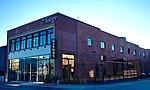
The Crane Building, also known as C.E. Erickson Co., in Des Moines, Iowa, United States. Crane Company was a plumbing and heating supplier and manufacturer that had this six-story manufacturing facility built in 1916. It was designed by the Des Moines architectural firm of Sawyer and Watrous. It is a utilitarian structure that is significant for its "thoughtful design" that utilizes elements of the Chicago School and a refined style. It was listed on the National Register of Historic Places in 2001. In 2013, the vacant building was renovated into 36 lofts targeted at artisans and costing 8 million dollars.

Excerpt from the Wikipedia article Crane Building (Des Moines, Iowa) (License: CC BY-SA 3.0, Authors, Images).

Crane Building (Des Moines, Iowa)
Locust Street, Des Moines

Geographical coordinates (GPS) Address Nearby Places
placeShow on map

Wikipedia: Crane Building (Des Moines, Iowa)Continue reading on Wikipedia

Geographical coordinates (GPS)

Latitude Longitude
N 41.584166666667 ° E -93.635833333333 °
placeShow on map

Address

G.W. Jones Building

Locust Street 1430
50309 Des Moines
Iowa, United States
mapOpen on Google Maps

Crane Building Des Moines, Iowa
Share experience

Nearby Places

Studebaker Corporation Branch Office Building

The Studebaker Corporation Branch Office Building, also known as the Iowa Truck and Tractor Co., Apperson Iowa Motor Car Co., Sears Auto Co., and the Sanders Motor Co., is a historic building located in Des Moines, Iowa, United States. This is actually two adjacent buildings, built four years apart. The building at 1442 Locust Street was completed in 1918 to house a Studebaker dealership, auto repair shop, and a corporate branch office. The addition of the corporate office made this building different from the others on Des Moines' "Auto Row," where it is located. The building was designed by the prominent local architectural firm of Proudfoot, Bird & Rawson, and built for the Hubbell Building Company who leased it out. The first floor was the location for Glass & Patton, the local Studebaker dealer. The second floor was where Studebaker's wholesale business in the state of Iowa was conducted. The third floor was a store room for automobiles. Studebaker's tenure here was short-lived, and by 1919 other auto and truck related businesses started to occupy the building. The building at 1436 Locust Street was built in 1922 between two existing buildings, which means it only has party walls. It too housed car dealerships in its early years. It was acquired by Sanders Motor Company in 1937 to house their used cars. Sanders already owned and occupied 1442 Locust Street. The two buildings were incorporated in 1948 with the opening of the party wall on the first floor. The building was listed on the National Register of Historic Places in 2015.

F. W. Fitch Company Historic District

The F. W. Fitch Company Historic District is a nationally recognized historic district located in Des Moines, Iowa, United States. It was listed on the National Register of Historic Places in 2013. At the time of its nomination the district consisted of five resources, including three contributing buildings, one contributing structure, and one non-contributing building. The industrial buildings were built piecemeal between 1917 and 1944 on the west side of the central business district. The main building (1917) and its addition (1929) are located on the north side of Walnut Street, and the soap plant (1929 & 1942) and the soap plant annex (1944) are located on the south sides of Walnut Street. The contributing structure is a tunnel under Walnut that was built either in 1929 or 1942. The F. W. Fitch Company, which manufactured personal care products, occupied the buildings between 1917 and 1949. They dominated much of the shampoo industry from the 1920s through the mid-1940s. They and the Carl Weeks' Armand Co., a national cosmetics and perfume manufacturer, gave the city a reputation as a leader in the United States for the personal care products industry. The country's changing grooming styles and the end of military contracts after World War II led to the company's demise. They sold all of their assets to Grove Laboratories of St. Louis in 1949. The Fitch family, however, continued to hold the title to the main building into the 1970s when Building Maintenance Services (BMS) bought it. The building housed artists and other design professionals. It was almost torn down in the early 21st century, but it was spared. Various enterprises have been housed in the soap plant and its annex.