place

Elektrozavodskaya (Arbatsko-Pokrovskaya line)

Arbatsko-Pokrovskaya LineCultural heritage monuments of regional significance in MoscowMoscow Metro stationsRailway stations in Russia opened in 1944Railway stations located underground in Russia
Stalinist architecture
Moscow Elektrozavodskaya metro station asv2018 09

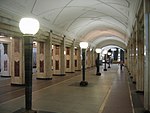
Elektrozavodskaya (Russian: Электрозаво́дская) is a Moscow Metro station on the Arbatsko-Pokrovskaya Line. It is one of the better-known stations of the system. Built as part of the third stage of the Moscow Metro and opened on 15 May 1944 during World War II, the station is one of the iconic symbols of the system, famous for its architectural decoration which is work of architects Vladimir Shchuko (who died whilst working on the station's project in 1939) and Vladimir Gelfreich, along with participation of his student Igor Rozhin. The station serves the Basmanny district and is located on the Bolshaya Semyonovskaya Street, next to the Yauza River. The railway station Elektrazavodskaya of the Kazan direction is also located nearby. In May 2007, the station was closed for a year during which the escalators were completely replaced, along with the floor panels. Most of the details and finishes including Motovilov's bas-reliefs were refurbished. The station was reopened on 28 November 2008. By 2022, the station will be open to go to the Bolshaya Koltsevaya line named Elektrozavodskaya.

Excerpt from the Wikipedia article Elektrozavodskaya (Arbatsko-Pokrovskaya line) (License: CC BY-SA 3.0, Authors, Images).

Elektrozavodskaya (Arbatsko-Pokrovskaya line)
Гольяновский проезд, Moscow Basmanny District

Geographical coordinates (GPS) Address External links Nearby Places
placeShow on map

Wikipedia: Elektrozavodskaya (Arbatsko-Pokrovskaya line)Continue reading on Wikipedia

Geographical coordinates (GPS)

Latitude Longitude
N 55.7817 ° E 37.7037 °
placeShow on map

Address

Электрозаводская

Гольяновский проезд
105094 Moscow, Basmanny District
Moscow, Russia
mapOpen on Google Maps

linkWikiData (Q1327563)
linkOpenStreetMap (242546355)

Moscow Elektrozavodskaya metro station asv2018 09
Share experience

Nearby Places

Preobrazhenskoye Cemetery

Preobrazhenskoye Cemetery (Russian: Преображенское кладбище, lit. Transfiguration Cemetery) is a cemetery in the eastern part of Moscow long associated with Old Believers. It was inaugurated by a Fedoseevtsy merchant in 1777 as a plague quarantine disguising the Bespopovtsy monastery. At that time the territory of the cemetery was located outside Moscow, but near its border. The cemetery soon became the spiritual and administrative center of all the Fedoseevtsy in Russia (just like the Rogozhskoe cemetery became an administrative and cultural centre for most Popovtsy Old Believers). The cloister consisted of two equal square areas, a monastery for men and a nunnery for women, separated by a road to the cemetery. Construction work was in progress throughout the 1790s and the first decade of the 19th century. At that time, the monastery asylum was home to 1,500 people, while the chapels were attended by as many as 10,000 Old Believers. Every church within the monastery was styled a chapel; like other Bespopovtsy, the Fedoseevtsy reject priesthood, and so even their largest temples are called chapels rather than churches, since they have no altar. The area was surrounded by brick walls with decorative pseudo-gothic towers. In the mid-19th century the "male" part of the monastery was confiscated from the Fedoseevtsy by the imperial administration to be transformed into the monastery of the Edinovertsy, the only legal denomination of Old Believers in Imperial Russia. The cloister, which came to be known as the St Nicholas Monastery of the Edinovertsy, boasted the largest collection of Old Believer literature (the Khludov bequest) and as many as 1,300 ancient icons. After the October Revolution the St. Nicholas Monastery was occupied by the Obnovlentsy, while the icons and the books were taken to the State Historical Museum and the Tretyakov Gallery. Later the monastery was divided between the Pomortsy Old Believers and the nearby parish of the official Russian Orthodox Church. The orthodox parish took a church above the gates with surrounding quarters, a bell-tower and a western part of the temple. The eastern part of the temple and several utilities in the western part of the territory belong to Pomortsy. The two parts of a single temple are currently separated by a thick brick wall, and compartments are occupied by different denominations. The women's part of Preobrazhenka avoided such a dissension, and still belongs to the Fedoseevtsy. The cemetery is also noted as a place where the first Eternal flame in Moscow was kindled in order to commemorate the World War II dead.