place

King Fahd Mosque (Sarajevo)

All Wikipedia neutral point of view disputesBosnia and Herzegovina building and structure stubsBosnia and Herzegovina–Saudi Arabia relationsEuropean mosque stubsMosques in Sarajevo
Wikipedia neutral point of view disputes from March 2023
King Fahd Mosque Sarajevo (6)

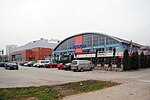
King Fahd Mosque (Bosnian: Džamija kralja Fahda) also known as King Fahd Bin Abdul Aziz Alsaud Mosque in Alipašino polje, Sarajevo, Bosnia and Herzegovina. The largest mosque in Sarajevo, Bosnia and Herzegovina is the King Fahd Mosque. The religious building was established and funded by Saudi Arabia. The monument is known to attract Muslims from across the city and state to its doorsteps. A stunning structure, it is a major landmark in the city. The King Fahd Mosque is the biggest in the Balkans.

Excerpt from the Wikipedia article King Fahd Mosque (Sarajevo) (License: CC BY-SA 3.0, Authors, Images).

King Fahd Mosque (Sarajevo)
Semira Frašte, Sarajevo Alipašino polje (Novi Grad Municipality)

Geographical coordinates (GPS) Address Nearby Places
placeShow on map

Wikipedia: King Fahd Mosque (Sarajevo)Continue reading on Wikipedia

Geographical coordinates (GPS)

Latitude Longitude
N 43.83965 ° E 18.343305555556 °
placeShow on map

Address

Džamija Kralj Fahd

Semira Frašte
71124 Sarajevo, Alipašino polje (Novi Grad Municipality)
Federation of Bosnia and Herzegovina, Bosnia and Herzegovina
mapOpen on Google Maps

King Fahd Mosque Sarajevo (6)
Share experience

Nearby Places

Dobrinja
Dobrinja

Dobrinja (Serbian Cyrillic: Добриња) is a neighbourhood in the western outskirts of Sarajevo, part of the municipality of Novi Grad. It is estimated to have a population of 25,063 inhabitants. Its name comes from the short river Dobrinja that flows through it. It is today organised in four local communities (MZ Dobrinja A, B, C, and D). Dobrinja lies just north of Sarajevo International Airport. The first phase of settlement construction was completed in 1983 with the settlement areas of Dobrinja I and Dobrinja II, used as Olympic Villages for the accommodation of sportspeople and foreign journalists in Sarajevo for the 1984 Winter Olympics. They included two residential neighbourhood, one school, and a trolleybus line to link it with the city centre. Dobrinja III, with its primary school, was the next phase in the second half of the 1980s. By the early 1990s Dobrinja IV and V were built and occupied. The newest blocks. These newest settlements suffered most damage during the conflict, as they were repeatedly bombed by the Army of Republika Srpska, and all three schools were destroyed. Overall, during the Siege of Sarajevo (1992–95), Dobrinja was the most bombed neighbourhood of Sarajevo. In 1993 a mortar attack was conducted from Serb-held positions on a football game. 13 people died and over 130 were wounded. Most of Dobrinja lies west of the inter-entity boundary line, in the territory of Sarajevo Canton. Only its eastern parts (Dobrinja IV, Soko and parts of Dobrinja I) are in the territory of Republika Srpska, in the municipality of Istočna Ilidža, where the main bus station for Istočno Sarajevo is located. The inter-entity boundary line posed certain problems in the case of Dobrinja, as it passed through apartment buildings and individual apartments. The residents were often confused about where to get the utilities such as electricity or water, or postal services. In response, some efforts were made to revise the boundary line through Dobrinja, but the communities involved failed to reach an agreement. By year 2001, the international High Representative appointed a former irish Circuit Court judge Diarmuid Sheridan as an independent arbitrator, who re-drew the revised inter-entity boundary line, affecting Dobrinja I and IV, and eliminated the most pressing problems.Dobrinja hosts today four primary schools, named after Skender Kulenović, Ćamil Sijarić, Osman Nuri Hadžić and Viktor Vrdoljak, and two secondary schools, the Dobrinja Gymnasium (Gimnnazija Dobrinja) and the Sarajevo Fifth High School (Peta gimnazija).

Siege of Sarajevo
Siege of Sarajevo

The siege of Sarajevo (Bosnian: Opsada Sarajeva) was a prolonged blockade of Sarajevo, the capital of Bosnia and Herzegovina, during the Bosnian War. After it was initially besieged by the forces of the Yugoslav People's Army, the city was then besieged by the Army of Republika Srpska. Lasting from 5 April 1992 to 29 February 1996 (1,425 days), it was three times longer than the Battle of Stalingrad, more than a year longer than the siege of Leningrad, and was the longest siege of a capital city in the history of modern warfare.When Bosnia and Herzegovina declared independence from Yugoslavia after the 1992 Bosnian independence referendum, the Bosnian Serbs—whose strategic goal was to create a new Bosnian Serb state of Republika Srpska (RS) that would include Bosniak-majority areas—encircled Sarajevo with a siege force of 13,000 stationed in the surrounding hills. From there they assaulted the city with artillery, tanks, and small arms. From 2 May 1992, the Serbs blockaded the city. The Bosnian government defence forces (ARBiH) inside the besieged city, approximately 70,000 troops, were poorly equipped and unable to break the siege. The siege was eventually lifted following a NATO air campaign codenamed Operation Deliberate Force, which paved the way for the Dayton Agreement which ended the Bosnian War. A total of 13,952 people were killed during the siege, including 5,434 civilians. The ARBiH sustained 6,137 fatalities, while Bosnian Serb military casualties numbered 2,241 killed soldiers. The 1991 census indicates that before the siege, the city and its surrounding areas had a total population of 525,980. According to some estimates, the total population of the city proper prior to the siege was 435,000. Estimates of the population of Sarajevo after the siege ranged from 300,000 to 380,000. Sarajevo's population endured up to six months without gas, electricity or water supply during certain stages of the siege.After the war, the International Criminal Tribunal for the former Yugoslavia (ICTY) convicted four Serb officials for numerous counts of crimes against humanity which they committed during the siege, including terrorism. Stanislav Galić and Dragomir Milošević were sentenced to life imprisonment and 29 years imprisonment respectively. Their superiors, Radovan Karadžić and Ratko Mladić, were also convicted and sentenced to life imprisonment.

High Judicial and Prosecutorial Council of Bosnia and Herzegovina

The High Judicial and Prosecutorial Council of Bosnia and Herzegovina (HJPC BiH) (Bosnian: Visoko sudsko i tužilačko vijeće BiH, VSTV BiH) is the national council of the judiciary of Bosnia and Herzegovina. It is the self-regulatory body of the judiciary in the country, tasked with guaranteeing its independence, with countrywide competences over the administration and career management of judicial office holders. It is based on the continental tradition of self-management of the judiciary. The High Judicial and Prosecutorial Council of Bosnia and Herzegovina (HJPC) is the single managing body responsible for guaranteeing the independence of judges and the autonomy of prosecutors throughout the country and regulating their careers. The HJPC BiH appoints, promotes, and disciplines judges and prosecutors at all levels in the country, and is responsible for advising other levels of government about judicial budgets and administration. The HJPC was established in 2004, replacing entity-level judicial and prosecutorial councils, on the basis of a transfer agreement from the entities, confirmed by the Constitutional Court. The Law on the High Judicial and Prosecutorial Council (HJPC) needs to be revised to better regulate the appointment, appraisal and disciplinary procedures of members of the judiciary, and provide appropriate legal remedies against final decisions of the HJPC, in line with European standards. It shares the same premises as the Court of Bosnia and Herzegovina, in Sarajevo's Otoka district.