place

Kanayannur

Ernakulam district geography stubsUse Indian English from November 2018Villages in Ernakulam district

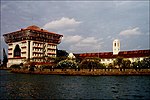
Kanayannur is a taluk and a village in the district of Ernakulam, in the Indian state of Kerala. Taluk is an administrative denomination in India.

Excerpt from the Wikipedia article Kanayannur (License: CC BY-SA 3.0, Authors).

Kanayannur
AG Milne Road, Kochi Mattancherry

Geographical coordinates (GPS) Address Nearby Places
placeShow on map

Wikipedia: KanayannurContinue reading on Wikipedia

Geographical coordinates (GPS)

Latitude Longitude
N 9.9666666666667 ° E 76.266666666667 °
placeShow on map

Address

AG Milne Road

AG Milne Road
628002 Kochi, Mattancherry
Kerala, India
mapOpen on Google Maps

Share experience

Nearby Places

Coonan Cross Oath
Coonan Cross Oath

The Coonan Cross Oath, also known as the Great Oath of Bent Cross or Leaning Cross Oath, was taken on 3 January 1653, in Mattancherry, by a significant portion of the Saint Thomas Christian community in the Malabar region of India. This public declaration marked their refusal to submit to the authority of the Jesuits and the Latin Catholic hierarchy, as well as their rejection of Portuguese dominance in both ecclesiastical and secular matters. The Portuguese had established political and religious control over parts of India, seeking to enforce Latin Catholic practices upon the local Christian community, which followed its own traditions. At the Synod of Diamper in 1599, led by Archbishop Aleixo de Menezes, the Latin Church imposed several changes, including the use of Portuguese bishops, the Latin liturgy, Roman vestments, clerical celibacy, and the establishment of the Portuguese Inquisition in Goa, which also extended its jurisdiction to Cochin. The Saint Thomas Christians, whom the Portuguese referred to as "Nestorians," largely resisted these latinizations, as they were seen as an infringement on their longstanding religious customs. By 1653, dissatisfaction with the Latin Church's increasing control had grown significantly among the Saint Thomas Christians. The Coonan Cross Oath symbolized their collective resolve to break free from Portuguese influence. In response, the community elected Thoma I as their archdeacon and leader. They also sought to restore connections with older Eastern Christian traditions, rejecting the continued latinization efforts. Ahatallah was a Syrian bishop who had arrived in India and was viewed by many Saint Thomas Christians as a potential leader who could restore their traditional practices. His capture by Portuguese authorities, who feared his influence, and his subsequent disappearance fueled further resistance among the Saint Thomas Christians. Some accounts suggest that his fate played a direct role in prompting the Coonan Cross Oath, as the community feared the complete erosion of their traditions under Portuguese rule.

Thekkumbhagam Synagogue

The Thekkumbhagam Mattancherry Synagogue aka Thekkumbhagam Synagogue was a synagogue located in Mattancherry Jew Town, a suburb of Kochi, Kerala, in South India. It was built in 1647 AD. by the Malabar Jews, on land donated by the Maharajah of Cochin and was one of the oldest known synagogues in India. It was the fourth to be built in Mattancherry after they fled to Cochin from Muziris and it was one of three in the area, the others being the Kadavumbhagam Mattancherry Synagogue (1539 AD) and the Paradesi Synagogue (1568 AD) of the Paradesi Jews of Cochin. The name of the synagogue is believed to refer to a much older synagogue that once stood in Kodungaloor. The Thekkumbhagam palli (synagogue) was built in typical Kerala-style Jewish architecture and was almost identical to the nearby Paradesi Synagogue though it had a much longer breezeway and a different design of gatehouse. A curious feature of the synagogue were four ostrich eggs that were hung for good luck.In 1955, the entire congregation made aliyah to Israel leaving the synagogue in the care of S. Koder of the Paradesi community to be taken care and maintained. In the 1960s, the synagogue was torn down and a two-story residential house was constructed. The only remaining relic from this monument is the hekal that was brought and is currently preserved in The Magnes Museum in Berkeley, California, USA.It changed hands again and now a heritage hotel is being constructed.