place

Vasil Levski Boulevard

Bulgaria geography stubsEurope road stubsStreets in Sofia
Vasil Levski and Gurko cross section

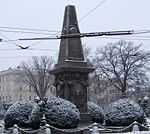
Vasil Levski Boulevard (Bulgarian: Булевард Васил Левски) is a major boulevard in Sofia, the capital of Bulgaria. It lies between the Freight Station Square at the Slivnitsa and Danail Nikolaev Boulevards and the area of the National Palace of Culture. It is named after Bulgaria's national hero Vasil Levski. Some of the most prominent landmarks of the capital are situated along the boulevard, including the National Academy of Arts, SS. Cyril and Methodius National Library, Sofia University, the State Agency of Youth and Sports, Battenberg Mausoleum, the Monument to Vasil Levski and others. Vasil Levski Boulevard crosses many of the city's vital transport arteries, such as Georgi Rakovski Street, Tsar Osvoboditel Boulevard at Sofia University, Patriarch Evtimiy Boulevard and Graf Ignatiev Street at Patriarch Evtimiy Square. The boulevard is served by many public bus and trolley bus lines and also SU St. Kliment Ohridski Metro Station.

Excerpt from the Wikipedia article Vasil Levski Boulevard (License: CC BY-SA 3.0, Authors, Images).

Vasil Levski Boulevard
bul. Vasil Levski, Sofia

Geographical coordinates (GPS) Address Nearby Places
placeShow on map

Wikipedia: Vasil Levski BoulevardContinue reading on Wikipedia

Geographical coordinates (GPS)

Latitude Longitude
N 42.694722222222 ° E 23.334722222222 °
placeShow on map

Address

СУ Св. Климент Охридски (Софийски Университет)

bul. Vasil Levski
1000 Sofia (Oborishte)
Bulgaria
mapOpen on Google Maps

Vasil Levski and Gurko cross section
Share experience

Nearby Places

Old Parliament House, Sofia

The National Assembly Building is used by the Bulgarian parliament for parliamentary debates. The main building has been proclaimed a monument of culture for its historic significance. Situated in downtown Sofia, it was designed in Neo-Renaissance style by Konstantin Jovanović, a Serbian-Bulgarian architect who received his education in Vienna and Switzerland and whose other works include the Parliament of Serbia building. It was constructed between 1884 and 1886 by Friederich Wilhelm Gustav Liebe, a young builder from Saxony who was only 22 years old when construction began. The building was originally painted in an off-white hue, but since the latter part of the 20th century has been white. In August 1990, the current national assembly building (the former party house) was set on fire by communist partisans.The building is depicted on the reverse of the Bulgarian 20 leva banknote, issued in 1999 and 2007. Due to insufficient space in the main building at Parliament Square, some administrative offices of the National Assembly are now housed by the former headquarters of the Bulgarian Communist Party, located at the Largo. There has been a proposal that the entire National Assembly be permanently moved to the Party House, with its inner courtyard being converted into an interior space for the plenary chamber.Since September 2020, it has been moved to the Party House. Surprisingly, after the April 2021 Bulgarian parliamentary election, the National Assembly moved again to the old Parliament House because the new opposition led-majority (ITN, Democratic Bulgaria, ISMV) viewed the Party House building as a symbol of Bulgaria's communist past.

Monument to the Tsar Liberator

The Monument to the Tsar Liberator (Bulgarian: Паметник на Цар Освободител, Pametnik na Tsar Osvoboditel) is an equestrian monument in the centre of Sofia, the capital of Bulgaria. It was erected in honour of Russian Emperor Alexander II who liberated Bulgaria from Ottoman rule during the Russo-Turkish War of 1877-78. The Neoclassical memorial's author is Italian sculptor Arnoldo Zocchi, who won the project in competition with 31 other artists from 12 countries (and with a total of 90 artists from 15 countries being interested) in the end of the 19th century. Bulgarian architect Nikola Lazarov participated in the monument's architectural design. The foundation stone was laid on 23 April 1901, St George's Day, in the presence of Knyaz Ferdinand I of Bulgaria, and the monument was completed on 15 September 1903. Ferdinand also attended the monument's inauguration on 30 August 1907 together with his sons Boris and Kiril, Grand Duke Vladimir Alexandrovich of Russia, son of Alexander II, together with his wife and his son, as well as other notable figures. Erected of black polished granite from Vitosha, the Monument to the Tsar Liberator consists of a pedestal, a middle part with figures and a massive Neo-Renaissance cornice finished with the sculpture of the Russian Tsar on a horse. The bronze wreath at the foot was donated by Romania in memory of the Romanian soldiers that died during the war. The main bronze bas-relief in the middle part depicts a group of Russian and Bulgarian soldiers led by the goddess of victory (Nike in Greek mythology and Victoria in Roman mythology), who raises her sword high above. Portraits of Grand Duke Nicholas Nicolaievich, Count Ignatiev and the generals Joseph Vladimirovich Gourko and Mikhail Skobelev surround the group. Other bas-reliefs feature scenes from the Battle of Stara Zagora, the signing of the Treaty of San Stefano and the opening ceremony of the Constituent National Assembly in Veliko Tarnovo, as well as portraits of Petko Slaveykov, Stoyan Zaimov, Ivan Vazov, Stefan Stambolov and other prominent figures from the period. The Monument to the Tsar Liberator is on Tsar Osvoboditel Boulevard, facing the National Assembly of Bulgaria and with the InterContinental hotel behind it.