place

Minsk Sports Palace

Buildings and structures completed in 1966Buildings and structures in MinskHC Dinamo MinskIce hockey venues in BelarusIndoor arenas built in the Soviet Union
Indoor arenas in BelarusKontinental Hockey League venuesSports venues completed in 1966
Minsk palace of sports 02 (cropped)

Minsk Sports Palace is an indoor sports arena, located in Minsk, Belarus. The arena seats 4,842 spectators and opened in 1966. It hosts various indoor events, including HC Dynamo Minsk and the Kontinental Hockey League before Minsk-Arena was completed.

Excerpt from the Wikipedia article Minsk Sports Palace (License: CC BY-SA 3.0, Authors, Images).

Minsk Sports Palace
праспект Пераможцаў, Minsk

Geographical coordinates (GPS) Address External links Nearby Places
placeShow on map

Wikipedia: Minsk Sports PalaceContinue reading on Wikipedia

Geographical coordinates (GPS)

Latitude Longitude
N 53.910679 ° E 27.54958 °
placeShow on map

Address

Дворец спорта

праспект Пераможцаў 4
220004 Minsk (Tsentralny District)
Belarus
mapOpen on Google Maps

linkWikiData (Q2067888)
linkOpenStreetMap (23571738)

Minsk palace of sports 02 (cropped)
Share experience

Nearby Places

Nyamiha
Nyamiha

The Nyamiha (Belarusian: Няміга, [nʲaˈmʲiɣa]; Russian: Немига, Nemiga, [nʲɪˈmʲiɡə]) is a river in Minsk. Today it is contained within a fabricated culvert. It discharges into the Svislach. The first mention of the river in historical chronicles is connected with the disastrous Battle on the Nemiga River, which took place on the riverbank in 1067, when the forces of the prince of Kievan Rus' defeated the forces of Polatsk princedom. The medieval epic The Tale of Igor's Campaign refers to the "bloody river banks of Nyamiha." Lines from the famous epic detail the battle: On the Nemiga the spread sheaves are heads, the flails that threshare of steel, lives are laid out on the threshing floor, souls are winnowed from bodies. Nemiga’s gory banks are not sowed goodly-sown with the bones of Russia’s sons.For a long time it was the second largest river flowing through Minsk, until it was adapted for its urban location by containment within a network of pipes. One part of the river was put into a pipe in 1926, and the rest in 1955. Today the river is a minor feature of the city environment, and the name Nyamiha more commonly refers to the street above. Niamiha Street is part of a shopping district famous for its amber craftwork. The Nyamiha metro station on the street was the site of a human stampede on May 30, 1999. Another incident on Nyamiha Street occurred on July 25, 2004, when a two-hour downpour in Minsk caused the storm sewers to overflow. Nyamiha Street and its environs were flooded.

Trinity Suburb
Trinity Suburb

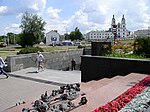
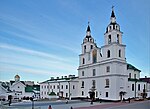
The Trinity Suburb (Trinity Hill, or Trajeckaje pradmiescie) is a historical district of Minsk located in the north-eastern part of the historical centre on the left bank of the Svislach river. It was the trade and administrative centre of the capital of Belarus in the past. In the northwest of the Trinity Suburb there is Tatarskaya Slabada, settled by Lipka Tatars from the 15th century (first settlement recorded in 1428) to mid-20th century, and Starastinskaya Slaboda, in the north - Storozhevka, in the east - Zolotaya Gorka, in the south - the central regions of the High and Low Markets.The first Catholic church in Minsk was located on the territory of the suburb. There were also the Ascension Monastery with the church of the same name, which have not survived to this day, St. Boris and Gleb Church, the Basilian Convent of the Holy Trinity (partially preserved) and the Church and Monastery of the Catholic monastic order. Nowadays the suburb is one of the most favorite places of Minsk residents and guests of the capital. Modern buildings of the district include the National Opera and Ballet Theatre, the Island of Tears, memorial that commemorates the Soviet soldiers died in the Afghanistan war in the 1970s. There are several hypotheses about the origin of the toponym "Trinity Hill". Most likely, the placename comes from the Catholic church of the Trinity, founded by Jogaila in 1390. According to another version, the toponym comes from the name of the defensive redoubt of the Holy Trinity, which was located near the Borisov outpost.