place

Pinery Provincial Park

1957 establishments in OntarioCampsites in CanadaForests of OntarioIUCN Category IIParks in Lambton County
Protected areas established in 1957Provincial parks of OntarioTemperate broadleaf and mixed forests in CanadaYear of establishment missing
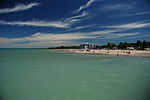
Pinery Provincial Park Entrance

Pinery Provincial Park is a provincial park located on Lake Huron near Grand Bend, Ontario. It occupies an area of 25.32 square kilometres (6,260 acres). It is a natural environment-class Provincial Park created to help preserve oak savannah and the beach dune ecology. It has 1,275 sites of which 404 have electrical hookups. These include the yurt camping area and the group camping sites. The initial package of land for the park was purchased from the Canada Company in 1957. In 1966, the park saw a 433-acre addition, adding 200 campsites to the park's existing 1,075 to accommodate the growth of the park patronage, which had reached peaks of 1,500 campers per day, causing many to be packed into overflow areas. Visitors to Pinery Provincial Park may access free wireless internet at the Visitor Centre provided by the Friends of Pinery Park.

Excerpt from the Wikipedia article Pinery Provincial Park (License: CC BY-SA 3.0, Authors, Images).

Pinery Provincial Park
Heritage Trail, Lambton Shores

Geographical coordinates (GPS) Address Nearby Places
placeShow on map

Wikipedia: Pinery Provincial ParkContinue reading on Wikipedia

Geographical coordinates (GPS)

Latitude Longitude
N 43.259958 ° E -81.827821 °
placeShow on map

Address

Heritage Trail

Heritage Trail
Lambton Shores
Ontario, Canada
mapOpen on Google Maps

Pinery Provincial Park Entrance
Share experience

Nearby Places

Port Franks, Ontario

Port Franks is a small Southern Ontario community in the municipality of Lambton Shores, Lambton County in southwestern Ontario, Canada. It is located along Kings Highway 21 near Pinery Provincial Park, about 8 kilometres (5.0 mi) north of Thedford, Ontario. Archaeological evidence suggests that human habitation and use of this site date back thousands of years, and that locally obtained flint was manufactured at the so-called 'flint chipping beds' in the vicinity long before the period of European contact with First Nations peoples in the Great Lakes Basin. The "Port Franks" reserve (named for company official Charles Franks and not, as is commonly reported, a Lake Huron sloop captain) was initially laid out by the Canada Company north of the present day village of Grand Bend. However, by 1851 its location was moved south to near the mouth of the Ausable River.The village was caught up in a series of rather public battles between Canada Company officials, Frederick Widder in Toronto and Thomas Mercer Jones in Goderich. Heartened by published reports, early in 1851 Robert McBride of Haldimand County travelled to the site and ultimately attempted, with much difficulty, to obtain land at Port Franks. It was only upon meeting with Canada Company officials in Goderich did McBride learn that contrary to what officials in Toronto may have believed no townsite had actually been surveyed. When legal action was threatened company officials quickly made provisions for a survey to be completed. Over the next few years a small settlement grew up around a couple of taverns and in 1854 Robert McBride was named the first postmaster. (The post office would close in 1856 with McBride's departure, but was reopened again in 1873). A series of disputes and legal wrangling stunted the community's growth, and led to McBride's departure in 1856.The tiny population, much maligned by many in the surrounding townships, lived an isolated existence behind rows of sand dunes that made landward access to the site difficult. The small permanent population of approximately seventy people subsisted on fishing and lumbering and the making of wooden shingles. Attempts throughout the 1850s, 1870s and 1880s to attract a series of railways and develop a harbour of refuge all came to nothing; railway connections to Strathroy, Stratford, and Arkona, Ontario were defeated. The discovery of salt and the construction of a 'Salt Block' brought a modicum of prosperity to the community in the 1890s, but this ultimately closed after only a few years in operation. A second salt industry briefly flourished in the 1930s before it too closed.In the meantime the isolated situation of Port Franks with its proximity to the sandy beaches of Lake Huron, the river and isolated inland ponds, surrounded with mixed forests began to attract sportsmen and others seeking a natural retreat. Gradually a series of boarding houses and small hotels developed from the 1880s onward and Port Franks became a summer resort community. By the 1890s private individuals began constructing summer cottages which increasingly became the life-blood of the community. The number of seasonal residences increased throughout the first half of the twentieth century and exploded in the post-1945 period with a series of 'suburban' developments including Windsor and Richmond Parks. Similarly, marine traffic for pleasure craft increased dramatically and the Ausable became lined with marinas. By the end of the twentieth century Port Franks boasted a permanent population of over 700 and a summertime population of close to 2,000. The increase in development has led to many attempts to preserve the community's unique natural heritage and led to the creation and preservation of various pockets of threatened natural vegetation and wildlife. In 2015 a marker was erected by the Municipality of Lambton Shores designating the cemetery in Port Franks. Port Franks is home to the Karner Blue Sanctuary.

Ausable River (Lake Huron)

The Ausable River is a river in southwestern Ontario Canada which empties into Lake Huron at Port Franks, Ontario. The Ausable's initial source is in a moraine near the community of Staffa, Ontario located in the municipality of West Perth, Ontario at a point 334 metres (1,096 ft) above sea level. Although the river has a total measured length of over 240 kilometres (150 mi), because of its meandering course, the mouth in actuality is only 64 kilometres (40 mi) from its source near Staffa. The Ausable drains 1,142 square kilometers (441 sq mi) of land, and falls 158 metres (518 ft) in elevation from source to outlet. In 1875, engineers of the Canada Company engaged in a large scale drainage project, referred to locally as "The Cut", which altered the course of the river dramatically and permitted the draining of several local small lakes and wetlands for agricultural purposes. Before that time the Ausable passed through the village of Grand Bend, where it made an abrupt curve toward the south, paralleling the Lake Huron shoreline for several kilometers, before entering the lake at Port Franks. This abrupt "bend" in the course of the river, is the origin of the name of the community of Grand Bend. The former course of the river, sections of which almost completely dry up during the summer season, can still be seen in Pinery Provincial Park. It is referred to as the Old Ausable Channel. The river provides habitat for several endangered freshwater mussel species, several threatened or endangered fish species and the threatened eastern spiny softshell turtle. The formation of the Ausable Gorge by the river near Arkona has exposed fossils from the Middle Devonian period. At one time, a hydroelectric plant was located at nearby Rock Glen Falls. This river was called Rivière aux Sables or "sandy river" by the French which through time became the Aux Sables River in English. The name was condensed to Ausable in the early 20th century. The Anishinaabeg people who signed Huron Tract Treaty #29 referred to the river as “Niigaanziibii” / Niigaansibiing” and the river is the eastern boundary of the Stony Point reserve which is 1/2 of the land base for the Anishinaabeg Of Kettle and Stony Point First Nations Band (Chippewas of Kettle and Stony Point First Nation -CKSPFN).