place

Resaca de la Palma Battlefield

Brownsville, TexasCommons category link is locally definedConflict sites on the National Register of Historic Places in TexasMexican–American WarNational Historic Landmarks in Texas
National Register of Historic Places in Cameron County, Texas
Resaca De La Palma Battlefield 2012 09 04 11 07 21

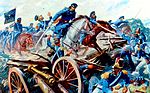
The Resaca de la Palma Battlefield is the site in Brownsville, Texas, where American forces under General Zachary Taylor engaged Mexican forces under General Mariano Arista on May 9, 1846 in the Battle of Resaca de la Palma. A surviving undeveloped portion of the battlefield is now part of the Palo Alto Battlefield National Historical Park, and was designated a National Historic Landmark in 1960.

Excerpt from the Wikipedia article Resaca de la Palma Battlefield (License: CC BY-SA 3.0, Authors, Images).

Resaca de la Palma Battlefield
Paredes Line Road, Brownsville

Geographical coordinates (GPS) Address Nearby Places
placeShow on map

Wikipedia: Resaca de la Palma BattlefieldContinue reading on Wikipedia

Geographical coordinates (GPS)

Latitude Longitude
N 25.9375 ° E -97.486111111111 °
placeShow on map

Address

Battle of Resaca de la Palma

Paredes Line Road
78526 Brownsville
Texas, United States
mapOpen on Google Maps

Resaca De La Palma Battlefield 2012 09 04 11 07 21
Share experience

Nearby Places

Brownsville, Texas
Brownsville, Texas

Brownsville () is a city in and the county seat of Cameron County in the U.S. state of Texas. It is on the western Gulf Coast in South Texas, adjacent to the border with Matamoros, Tamaulipas, Mexico. The city covers 145.2 sq mi (376.066 km2), and had a population of 186,738 at the 2020 census. As of the 2020 US Census, it is the 139th-largest city in the United States and 18th-largest in Texas. It is part of the Matamoros–Brownsville metropolitan area. The city is known for its year-round subtropical climate, deep-water seaport, and Hispanic culture. The city was founded in 1848 by American entrepreneur Charles Stillman after he developed a successful river-boat company nearby. It was named for Fort Brown, itself named after Major Jacob Brown, who fought and died while serving as a U.S. Army soldier during the Mexican–American War (1846–1848). As a county seat, the city and county governments are major employers. Other primary employers fall within the service, trade, and manufacturing industries, including a growing aerospace and space transportation sector. It operates international trading through the Port of Brownsville. The city experienced a population increase in the early 1900s, when steel production flourished. Due to significant historical events, the city has multiple houses and battle sites listed under the National Register of Historic Places. The city played a primary role in the Mexican–American War with the Siege of Fort Texas and the first engagements of the war: The Battle of Palo Alto and The Battle of Resaca de la Palma. Several key events of the American Civil War took place in the city, such as the Battle of Brownsville and the Battle of Palmito Ranch. The city was also involved in the Texas Revolution. Brownsville's idiosyncratic geographic location has made it a wildlife refuge center. Several state parks and historical sites are protected by the Texas Parks and Wildlife Department. Brownsville has a predominantly Hispanic population, which at 93.9% is the third-highest proportion of Hispanic Americans of any city in the United States outside of Puerto Rico.