place

Embassy of Ukraine, Moscow

Diplomatic missions in MoscowDiplomatic missions of UkraineForeign relations stubsRussian building and structure stubsRussia–Ukraine relations
Ukraine politics stubs
Embassy of Ukraine in Moscow

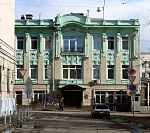
The Embassy of Ukraine in Moscow was the chief diplomatic mission of Ukraine in the Russian Federation. It was located at 18 Leontyevsky Lane (Russian: Леонтьевский переулок, 18) in Moscow.In March 2014, as a result of the Annexation of Crimea by the Russian Federation, Ukraine recalled its ambassador and Ukraine was represented by its temporary chargé d'affaires until the start of the Russian invasion of Ukraine on 24 February 2022. Ukraine severed diplomatic relations with Russia and evacuated its entire embassy personnel from Moscow that day. The embassy's personnel were officially welcomed to the Latvian capital, Riga, on 4 March.

Excerpt from the Wikipedia article Embassy of Ukraine, Moscow (License: CC BY-SA 3.0, Authors, Images).

Embassy of Ukraine, Moscow
Леонтьевский переулок, Moscow Presnensky District

Geographical coordinates (GPS) Address Nearby Places
placeShow on map

Wikipedia: Embassy of Ukraine, MoscowContinue reading on Wikipedia

Geographical coordinates (GPS)

Latitude Longitude
N 55.7606 ° E 37.6057 °
placeShow on map

Address

Леонтьевский переулок 18/17
125009 Moscow, Presnensky District
Moscow, Russia
mapOpen on Google Maps

Embassy of Ukraine in Moscow
Share experience

Nearby Places

Kamerny Theatre
Kamerny Theatre

The Kamerny Theatre was a chamber theatre in Moscow, founded in 1914 by director Alexander Tairov (1885–1950). Over the next 35 years, this small, intimate theater became "recognized as a major force in Russian theater". Considered among the better presentations staged at the theater were: Princess Brambilla (1920), Phèdre and Giroflé-Girofla (1922), Desire Under the Elms (1926), Day and Night (1926), The Negro (1929), The Beggars' Opera (1930) and Vishnevsky's An Optimistic Tragedy (1933). Tairov's primary collaborator in building the sets was Aleksandra Ekster, and these were based upon the period's constructivist style. The decor for the theatre was designed by Konstantin Medunetsky.For three decades the theater survived the effects of the Russian Revolution by remaining unpolitical, instead adopting a post-revolutionary romantic idealism and relying heavily on classical material from the east and west. However, in 1928, the Kamerny put on Purple Island by Mikhail Bulgakov, which was a satire that openly mocked the government. As a result, Stalin labeled the Kamerny 'a real bourgeois theater'. Thereafter, the theater had need to reform their presentation. The Soviet authorities developed a deep distrust of Tairov, calling him the last representative of the "bourgeois aestheticism".In 1937, the Realistic Theater was merged with the Kamerny. In World War II, the theater was heavily bombed during the siege of Moscow and it did not re-open until December 25, 1943. The last production staged at the Kamerny was The Seagull by Anton Chekhov in 1946. The same year the Soviet communist party "condemned all formalism and experimentation in literature and the arts". The Kamerny was closed in 1949 as a result of the Zhdanov Doctrine.