place

GIFT City

Buildings and structures under construction in IndiaChief Ministership of Narendra ModiEconomy of AhmedabadEconomy of GujaratFinancial districts in India
Financial services in IndiaGIFT CityPages with non-numeric formatnum argumentsPlanned communities in IndiaProposed infrastructure in GujaratScience and technology in Gujarat
Night view of GIFT City

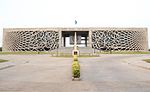
Gujarat International Finance Tec-City (GIFT City) is a central business district under construction in Gandhinagar district in Gujarat, India. It is India's first operational greenfield smart city and international financial services center, which the Government of Gujarat promoted as a greenfield project. In 2020 GIFT IFSC bagged 10th place in Finance Industry and top rank in emerging financial centres in Global Financial Centres Index .The city is located on the banks of the Sabarmati River and is around 12 km (7.5 mi) from Sardar Vallabhbhai Patel International Airport. The city is designed so residents can walk to work, and includes commercial, financial and residential complexes.The city is connected through 4-6 lane State and National Highways. A metro station is also planned for construction, which would connect GIFT City to the Ahmedabad Metro network, and is expected to be completed by March 2024.The total area for the development of GIFT is 886 acres out of which the SEZ (Special Economic Zone) constitutes 261 acres. The project area under development can hence be classified under the SEZ area and the Non-SEZ area (also known as the Domestic Tariff area or the DTA).

Excerpt from the Wikipedia article GIFT City (License: CC BY-SA 3.0, Authors, Images).

Geographical coordinates (GPS)

Latitude Longitude
N 23.159722222222 ° E 72.684444444444 °
placeShow on map

Address


382355 , GIFT City
Gujarat, India
mapOpen on Google Maps

Night view of GIFT City
Share experience

Nearby Places

Pandit Deendayal Energy University

Pandit Deendayal Energy University (PDEU), formerly Pandit Deendayal Petroleum University (PDPU), has been established by GERMI as a Private University through the State Act enacted on 4 April 2007. The university is located at Raysan village of Gandhinagar city in an area known as Knowledge Corridor, and it is near the GIFT City. It is 8 km from Gujarat state capital Gandhinagar, and 23 km from Gujarat's largest city Ahmedabad. Pandit Deendayal Energy University has been awarded Scientific & Industrial Research Organization (SIRO) recognition by Department of Scientific and Industrial Research, Ministry of Science & Technology, Government of India.PDEU has been ranked as no. 1 Private University in Gujarat and has received "Centre of Excellence Status" (in Principle) by Government of Gujarat. The university has four schools, located on the same campus. The schools include the School of Energy Technology (SoET)(formerly, School of Petroleum Technology(SPT)), the School of Technology (SoT), the School of Management (SoM) (formerly, School of Petroleum Management), and the School of Liberal Studies (SLS). The President of University Board of Governors is Dr. Mukesh Ambani and the Chairman of the Standing Committee is Dr. HAsmukh Adhia.The university also has its own one megawatt solar power plant. The Government of Gujarat has decided to set up an international Centre of Excellence in Automobile at PDPU with investment of Rs. 150 Crores (US$ 25M) in joint venture with Maruti Suzuki.

Swaminarayan Mandir Vasna Sanstha

Swaminarayan Mandir Vasna Sanstha (SMVS) is a Hindu denomination within the Swaminarayan Sampradaya. It was founded in 1987 by Devnandandasji Swami, usually addressed as HDH Bapji by his devotees and followers, It propagates the preaching and teaching of Swaminarayan as explained by Devnandandasji Swami. Its current leader is Jivanpran Abajibapashri. Multifaceted activities in areas like social, cultural, educational, religious fields are carried out by SMVS under the directions and guidance of Bapji and his second in-command and current Guru Satyasankalpdasji Swami, who is usually addressed as HDH Swamishri. From a modest beginning in 1987, SMVS has developed into a multifaceted institution. SMVS has 100 main centres throughout Gujarat and abroad, wherein 100 saints, 100 lady saints, and about 10,000 volunteers are entrusted religious duties. Many of their saints and devotees have visited India, UK, USA, Canada, Australia, New Zealand, Kenya, Uganda, Zambia, Bahrain, Kuwait, Dubai, and other parts of the world to propagate preaching and teaching of Sahajanand Swami and also to monitor construction and expansion of SMVS Swaminarayan temples as well as other related religious and cultural activities such as functioning of medical centres, old age homes, schools, hospitals, and other charities. SMVS operates in the educational field, medical-health services, tribal upliftment, natural calamities, etc. through SMVS Charities, a separate non-profit aid organization which has spearheaded a number of projects.

1969 Gujarat riots
1969 Gujarat riots

The 1969 Gujarat riots involved communal violence between Hindus and Muslims during September–October 1969, in Gujarat, India. The violence was Gujarat's first major riot that involved massacre, arson, and looting on a large scale. It was the most deadly Hindu-Muslim violence since the partition of India in 1947, and remained so until the 1989 Bhagalpur violence. According to the official figures, 660 people were killed, 1074 people were injured, and over 48,000 lost their property. Unofficial reports claim as high as 2000 deaths. The Muslim community suffered the majority of the losses. Out of the 512 deaths reported in the police complaints, 430 were Muslims. Property worth 42 million rupees was destroyed during the riots, with Muslims losing 32 million worth of property. A distinctive feature of the violence was the attack on Muslim chawls by their Dalit Hindu neighbours who had maintained peaceful relations with them until this point. The riots happened during the chief ministership of the Indian National Congress leader Hitendra Desai. The Justice Reddy Commission set up by his government blamed the Hindu nationalist organizations for the violence. Various writers trace the causes of the riots to a mix of socioeconomic and political factors. The riots started in Ahmedabad, and then spread elsewhere, notably Vadodara, Mehsana, Nadiad, Anand, and Gondal. By 26 September, the violence had been brought under control, however some more violent incidents happened during 18–28 October 1969.