place

Robert H. Sunday House

Buildings and structures in Marshalltown, IowaCentral Iowa Registered Historic Place stubsFrank Lloyd Wright buildingsHouses completed in 1960Houses in Marshall County, Iowa
Houses on the National Register of Historic Places in IowaModernist architecture in IowaNational Register of Historic Places in Marshall County, Iowa
Robert Sunday House 1

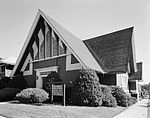
The Robert H. Sunday House is located in Marshalltown, Iowa, United States. It was designed by Frank Lloyd Wright in the Usonian style, and was listed on the National Register of Historic Places in 1988. Initially the Sunday's choose the Usonian Automatic, a natural concrete block model, for their home. When it provided unworkable, Wright sent the plans for this house. In style and materials it is very similar to the 1953 Usonian Exhibition House. It was the sixth of seven houses designed by Wright and built in this style in Iowa. Sunday, who owned Marshall Lumber in Marshalltown, acted as his own general contractor. In fact, he and his wife did much of the work themselves. It is also believed to be last of this style built in brick. John H. "Jack" Howe, a Wright assistant who supervised the initial construction, designed an addition to this house in 1970 that conforms seamlessly with the original. It includes the family room, family room terrace, and the dining room. The original house followed an L-shaped plan, and with the addition it is now a T-shaped plan. Howe had previously designed (1964) the building for Sunday's business.

Excerpt from the Wikipedia article Robert H. Sunday House (License: CC BY-SA 3.0, Authors, Images).

Robert H. Sunday House
Woodfield Drive, Marshalltown

Geographical coordinates (GPS) Address Nearby Places
placeShow on map

Wikipedia: Robert H. Sunday HouseContinue reading on Wikipedia

Geographical coordinates (GPS)

Latitude Longitude
N 42.026666666667 ° E -92.927777777778 °
placeShow on map

Address

Woodfield Drive 1757
50158 Marshalltown
Iowa, United States
mapOpen on Google Maps

Robert Sunday House 1
Share experience

Nearby Places

Marshalltown Downtown Historic District

The Marshalltown Downtown Historic District is a historic district located in Marshalltown, Iowa, United States. It was listed on the National Register of Historic Places in 2002. At the time of its nomination it contained 96 resources, which included 79 contributing buildings, one contributing site, and 16 non-contributing buildings. The historic district covers most of the city's central business district. All of it is within the original town of Marshalltown, which was laid out and recorded on August 15, 1853, as the village of Marshall. Confusion with a town with the same name in Henry County led this village to be renamed Marshalltown in 1862. It was incorporated the following year. The district contains a mix of commercial buildings, an opera house, a movie theater, a fraternal hall, and warehouses. The civic buildings include the Marshall County Courthouse, sheriff's residence, municipal building, civic auditorium and public library. The buildings range in size from narrow, two-story commercial blocks to three-story corner blocks, and the seven-story Hotel Tallcorn. The period of significance is from 1862 to 1950, and the buildings are constructed during that time frame. The commercial Italianate, Romanesque Revival, and especially vernacular architecture are dominant. Prominent architects who have buildings in the district include John C. Cochrane (courthouse; 1886), Patton and Miller (public library; 1902), Harry E. Reimer (Marshalltown Municipal Building; 1921), and Josselyn and Todd (Marshalltown Memorial Coliseum; 1929). A tornado struck Marshalltown on July 19, 2018. It did significant damage to many buildings in the historic district, including the courthouse, city hall, and the civic auditorium.

Newton Downtown Historic District (Newton, Iowa)

The Newton Downtown Historic District is a nationally recognized historic district located in Newton, Iowa, United States. It was listed on the National Register of Historic Places in 2014. At the time of its nomination it contained 85 resources, which included 60 contributing buildings, one contributing site, and 24 non-contributing buildings. Jasper County was established by the Iowa Territorial Legislature in 1846, and Newton was incorporated the following year as the county seat. The town grew slowly at first around the Jasper County Courthouse. Businesses largely served the needs of the local farmers as well as the town's residents. The Mississippi and Missouri Railroad, later the Chicago, Rock Island and Pacific Railroad, came to Newton in 1867. This changed the town's economy from agricultural-based to manufacturing, and the central business district expanded outward as the community grew. Several washing machine companies established themselves in Newton, most notably Maytag. The emergence of Maytag as a major corporation in the mid-20th century led to the transformation of the downtown area. Between 1951 and 1952, 18 businesses installed new storefronts, transforming them from their original Victorian appearance to a more modern appearance. The modernization continued into the 1960s. Various architects, mostly from Iowa, designed most of the important buildings in the district. The exception was Henry Raeder, a Chicago architect who designed the Hotel Maytag (1926). Most of the buildings in the district, however, were designed by local builder-contractors. All of the buildings are of masonry construction. A majority of the structures housed retail concerns on the main floor with apartments or offices on the upper floors. Other buildings housed banks, restaurants, service stations, the local newspaper, a hotel, and fraternal organizations. Three churches, the Salvation Army, First United Methodist, and First Presbyterian, are located in the district. Government buildings located here include the former city hall, former post office, and county public services. The present county courthouse (1911) is individually listed on the National Register. The courthouse square is the contributing site.