place

Snow King Mountain

Buildings and structures in Teton County, WyomingJackson, WyomingSki areas and resorts in WyomingTourist attractions in Teton County, Wyoming
Snow king
Snow king

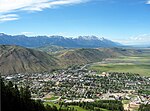
Snow King Mountain is a summer and winter resort in the western United States, in Jackson, Wyoming. The mountain is Jackson's original 1936 ski hill, located on the southeast edge of the city, and was the first ski area in Wyoming. Locals sometimes refer to Snow King as "The Town Hill," and it offers skiing, hiking, an alpine slide, and many other attractions. The ski season runs from December to late March, and has a summer season that runs from June to October. Skiing is offered after the closure of lifts, until the snow is gone thanks to a boot pack trail on the west side of the resorts Runs. Hiking trails are offered all over the mountain.

Excerpt from the Wikipedia article Snow King Mountain (License: CC BY-SA 3.0, Authors, Images).

Snow King Mountain
Leeks Canyon Road (No Access to Highway),

Geographical coordinates (GPS) Address External links Nearby Places
placeShow on map

Wikipedia: Snow King MountainContinue reading on Wikipedia

Geographical coordinates (GPS)

Latitude Longitude
N 43.472 ° E -110.761 °
placeShow on map

Address

Snow King Mountain

Leeks Canyon Road (No Access to Highway)
83001
Wyoming, United States
mapOpen on Google Maps

linkWikiData (Q7548259)
linkOpenStreetMap (1076348034)

Snow king
Snow king
Share experience

Nearby Places

George Washington Memorial Park (Jackson, Wyoming)

George Washington Memorial Park is located at the center of Jackson, Wyoming. More generally known as "Town Square", the park is notable for its elk-antler arches at each corner of the park, collected from the nearby National Elk Refuge by Boy Scouts and periodically rebuilt. The square originally existed as an open space in the center of town that was made into a park in 1934. The park center also contains a stone memorial to John Colter.The Town Square originated as an open space in the middle of Jackson where no buildings had yet been built, surrounded by more developed blocks in the sparsely settled street grid of the town. The area was used as a commons area by people and occasionally as a thoroughfare for migrating elk. In 1917 the town graded the surrounding street and obtained title to most of the land, using excess material from the grading to even out depressions in the square's surface. In 1924 the town undertook further improvements to the area, now called "the little park in the center of the town." The initiative yielded further grading. A few trees were planted, and were then indifferently maintained. With the two hundredth anniversary of the birth of George Washington approaching in 1932, the state of Wyoming cooperated with Congress to prepare memorials throughout the state. The Wyoming plan was to establish a George Washington Memorial Park in as many communities as possible. The Town Square was designated the George Washington Memorial Park for Jackson in 1932. The organizing committee, which included Olaus Murie, raised the requisite $150 in public donations to landscape the park. Plantings were not ready until 1933. However, labor shortages remained a problem, and little work was accomplished. Jackson applied for and received $3092 from the New Deal Civil Works Administration, which allowed the town to organize a land transfer allowing the sole building on the square property, the Independent Order of Odd Fellows Hall, to move to another site. Altogether, more than $6000 in CWA funds were expended, just before the CWA was closed down in 1934.In short order the Square became the center of Jackson's civic life. A memorial to John Colter was placed in the center of the park in 1939. In 1953 the local Rotary Club built an arch of elk antlers at the southwest corner of the park. Arches were erected at the remaining corners in 1966, 1967 and 1969.In 1959 a house originally built by Charles Wort was moved onto the square, becoming known as the "Stage Stop." The move was unpopular and possibly illegal, but the building remained until 1995 when it was given to Wyoming Senator Alan Simpson, whose grandfather had used the building as a law office. A modern replacement was built in its stead. It was not until 1976 that a plaque was placed in the park for the United States Bicentennial naming the park "George Washington Memorial Park." Stone facings were added to the antler arches the same year.

Van Vleck House and Barn

The Van Vleck House was built in Jackson, Wyoming in 1910–1011. The log house and barn are the only remaining residential structures in the vicinity of the Town Square.The Van Vleck House was built by Roy Van Vleck, operator of the first "mercantile", or general store, in Jackson. Roy and his new wife, Genevieve Lawton Van Vleck lived in the cabin from 1911 to 1960. The Van Vleck house was notable at the time for possessing its own well, which served much of the surrounding population. In 1920 Genevieve became one of the members of the first all-female town council in the United States, serving until 1923. Roy Van Vleck was the local land commissioner and served on the hospital and school boards. Van Vleck was also a leader of the opposition to the creation and expansion of Grand Teton National Park in the 1930s.The house is a one-story log cabin. The approximately 36-foot (11 m) by 60-foot (18 m) L-shaped house was moved 30 feet (9.1 m) after a 1988 fire and set on a new foundation. It retains its orientation and context. The interior did not survive the fire and has been reconstructed. The barn, which is a few years newer than the house, stands nearby. The barn includes a central brick chimney and is used for storage. The barn was the location for the final fight scene featuring Clint Eastwood in the 1980 movie Every Which Way But Loose.In 1980 the house became a restaurant. It was listed on the National Register of Historic Places in 1995, and is the only authentic historical structure in the central area of Jackson.

St. John's Episcopal Church and Rectory (Jackson, Wyoming)

St. John's Episcopal Church and Rectory form a complex of log structures in Jackson, Wyoming. The rectory was built first: in 1911 it was a hostel and community center under the supervision of Episcopal Bishop Nathaniel Thomas. Church services were held there until 1916, when the church was built. The church and hostel are among the largest log structures in Jackson Hole.The rectory was the first location in Jackson to hold regular Episcopal services, beginning in 1911. Services had been held intermittently since 1908. With the construction of the new church in 1916 the rectory was used as a hostel so that ranchers and lodgers at dude ranches more than a day's travel distant could stay overnight. The rectory was also used as a meeting place and social hall, and eventually as a community library with over 1000 volumes. The rectory is a 1-1/2 story building, featuring carefully built log dormers.The 1916 church was built by Butch and Ed Robinson of Jackson, using logs cut and cured by George and Clarence Blain, with finish work by master carpenter Raul A. Imeson. The church and rectory were designed using the locally prevailing rustic style that was becoming popular for dude ranches and park structures. The church measures approximately 60 feet (18 m) by 24 feet (7.3 m), covered with an open log-trussed roof. This building is now referred to as a chapel, since a new, larger church was built in 1995.The site also includes a 1950s rectory and a frame parish hall, both considered non-contributing structures. St. John's Church operates the Chapel of the Transfiguration in Grand Teton National Park. The church was instrumental in organizing the hospital in Jackson, now named St. John's Medical Center.