place

Temple Theater (Meridian, Mississippi)

Buildings and structures in Meridian, MississippiCinemas and movie theaters in MississippiEmile Weil buildingsMoorish Revival architecture in MississippiNational Register of Historic Places in Lauderdale County, Mississippi
ShrinersTheatres completed in 1924Theatres on the National Register of Historic Places in Mississippi
Meridian December 2018 25 (Temple Theater)

The Hamasa Shrine Temple Theater, added to the National Register of Historic Places in 1979, is a historic theater located at 2320 8th Street in Meridian, Mississippi. The Temple Theater was constructed in the Moorish Revival style and began screening silent films in 1928. The theater features a Byzantine motif, a swirl of marble fountains, and large bronze chandeliers. At the time of its construction, the theater contained one of the largest stages in the United States, second only to the Roxy Theater in New York City. The theater houses one of only two Robert Morton theatre organs still installed in their original locations in the State of Mississippi – the other being installed at the Saenger Theater in Hattiesburg, Mississippi. Both organs are under the care and restoration efforts of the Magnolia Chapter of the American Theatre Organ Society (ATOS).The Temple, originally used for vaudeville and movies, is now used year-round for area events, live stage shows, plays, and concerts.

Excerpt from the Wikipedia article Temple Theater (Meridian, Mississippi) (License: CC BY-SA 3.0, Authors, Images).

Temple Theater (Meridian, Mississippi)
8th Street, Meridian

Geographical coordinates (GPS) Address Nearby Places
placeShow on map

Wikipedia: Temple Theater (Meridian, Mississippi)Continue reading on Wikipedia

Geographical coordinates (GPS)

Latitude Longitude
N 32.365277777778 ° E -88.702130555556 °
placeShow on map

Address

Temple Theater for the Performing Arts

8th Street
39307 Meridian
Mississippi, United States
mapOpen on Google Maps

Meridian December 2018 25 (Temple Theater)
Share experience

Nearby Places

First Presbyterian Church of Meridian

First Presbyterian Church of Meridian is a historic church in Meridian, Mississippi, which is listed on the National Register of Historic Places. The church was founded in 1856 by eight members including John T. Ball and Lewis A. Ragsdale, founders of the city of Meridian. The reverend at the time was William Curtis Emerson.From 1856 to 1867, the church met in the second floor of a store owned by one of the members. In 1867, the church had grown enough to construct a building on the corner of 25th Avenue and 7th Street in which to hold its services. After a fire on January 27, 1883, the building was destroyed; members of the church later rebuilt the structure using brick instead of wood. The church remained at its location on 25th Avenue and 7th Street until September 25, 1911, when it was sold to the city of Meridian. The city currently uses the building to house the Meridian Museum of Art.After selling the old building, the church bought a lot at the corner of 23rd Avenue and 10th Street. The building, designed by architect Penn Jeffries Krouse, was built in 1913 and dedicated on March 29, 1914. In 1951, an educational building addition used for Sunday School was completed under the leadership of pastor Dr. J. Kelly Unger.It was listed on the National Register in 1979. It was deemed more notable than other churches in Meridian for "its historical significance" and because it was designed by P.J. Krouse, "architect of most of Meridian's outstanding buildings from 1900-1920".The sanctuary was renovated in 1982. In October 1996, the church bought an adjacent building which became the Administration & Education Building and is used for staff offices as well as both Adult Sunday School and committee meetings.

Threefoot Building
Threefoot Building

The Threefoot Building (sometimes referred to as simply "The Threefoot") is a historic office building located in downtown Meridian, Mississippi named after the Threefoot family who owned an operated a business in downtown Meridian during the late 19th century and early 20th century. Designed by Claude H. Lindsley and completed in 1929 in the Art Deco style, the 16-story building is still the tallest in the city. It was added to the National Register of Historic Places on December 18, 1979, under the Meridian Multiple Property Submission of buildings contributing to the historic nature of the city's downtown. In 2008 the Threefoot was recognized by the state as a Mississippi Landmark. Despite the completion of the building nearly immediately preceding the onset of the Great Depression, leading to the bankruptcy of the Threefoot family, the building was occupied by many different tenants until the 1990s, by which time suburban development had drawn off most of them in favor of peripheral locations. Hoping to attract new tenants to the building and the rest of downtown, in 2002 the city started the annual Threefoot Arts Festival, naming it after the building. After attracting some interest in the mid 2000s, the city's plans for redevelopment foundered with changes in city administration in 2009, resulting in the National Trust for Historic Preservation listing the building in 2010 in its annual group of "America's Most Endangered Places." In 2015 after extensive efforts by a newer administration, an agreement was reached in which the building was sold to a private developer and is project to be converted into a Courtyard by Marriott by the end of the year 2020.

Mississippi Arts and Entertainment Experience

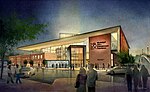
The Mississippi Arts and Entertainment Experience (The MAX) is an art museum that opened April 28, 2018 in downtown Meridian, Mississippi, United States. The 50 million dollar museum highlights Mississippi artists and celebrates the contributions of arts and entertainment enterprisers in every artistic discipline. The museum opened during Mississippi's bicentennial celebration. The institution's principal mission is education of the public by recognizing and honoring legendary artists and entertainers through interactive exhibits that visually, auditorily, and kinesthetically challenge, entertain, and inform visitors. The MAX housed in a contemporary, two-level structure contains 58,500 square feet of space. The facility was designed and planned by Meridian-based architectural firm, LPK Architects, P.A. with exhibit design by Gallagher & Associates. The exhibits are organized around six themes: Land, Community, Home, Church, People + Places, and Global Community. Within these six themes, there are 15 total permanent galleries of exhibits and two spaces for changing exhibits. Audio and video stories are used to communicate who, what, where, when, why, and how Mississippians have influenced all areas of the arts and the creative economy all over the world. Other elements include a Mississippi Arts + Entertainment Hall of Fame, museum store, recording studio, both a 2D art studio (painting and drawing) and a 3D art studio (ceramics), multi-purpose gallery, outdoor amphitheater, second-floor terrace, and courtyard. Walk of FameA Hollywood-style Walk of Fame, unveiled in 2009, makes its way from the nearby Mississippi State University Riley Center to the MAX site. New Walk of Fame stars will accompany the earlier state legends, including Elvis Presley, Jimmie Rodgers, B.B. King, William Faulkner, Morgan Freeman, Walter Inglis Anderson, Hartley Peavey, Sela Ward and others.