place

District Museum in Toruń

Art museums and galleries in PolandBuildings and structures in ToruńHistory museums in PolandMuseums in Kuyavian-Pomeranian VoivodeshipRegistered museums in Poland
Torun Ratusz Staromiejski 2010 03 04

Toruń Regional Museum (Polish: Muzeum Okręgowe w Toruniu), located in the Ratusz hall of Toruń, is one of the oldest and largest museums in Poland. It started in 1594 as the mere Cabinet of Curiosities at the library of the academic Gimnazjum, called Musaeum in Latin. Re-established in sovereign Poland as a city museum in 1920 after the century of military partitions, it was administratively structured as the regional museum in 1965.

Excerpt from the Wikipedia article District Museum in Toruń (License: CC BY-SA 3.0, Authors, Images).

District Museum in Toruń
Rynek Staromiejski, Toruń Stare Miasto (Stare Miasto)

Geographical coordinates (GPS) Address Nearby Places
placeShow on map

Wikipedia: District Museum in ToruńContinue reading on Wikipedia

Geographical coordinates (GPS)

Latitude Longitude
N 53.010833333333 ° E 18.604444444444 °
placeShow on map

Address

Ratusz Staromiejski

Rynek Staromiejski 1
87-100 Toruń, Stare Miasto (Stare Miasto)
Kuyavian-Pomeranian Voivodeship, Poland
mapOpen on Google Maps

Torun Ratusz Staromiejski 2010 03 04
Share experience

Nearby Places

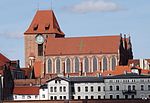
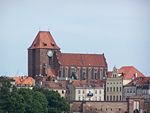
Toruń Cathedral
Toruń Cathedral

The Cathedral Basilica of St. John the Baptist and St. John the Evangelist (Polish: Bazylika katedralna św. Jana Chrzciciela i św. Jana Ewangelisty), also called Toruń Cathedral, is a Gothic cathedral and minor basilica located in the Old Town of Toruń, Poland, seat of the Roman Catholic Diocese of Toruń. As part of the Medieval Town of Toruń it is listed as a UNESCO World Heritage Site and a Historic Monument of Poland.One of three Gothic churches of the town, it is built from brick, an aisled hall with a monumental west tower. The first church from the 13th century was a small hall without aisles and with polygonal presbytery. This was replaced by aisled hall church in the first half of the 14th century, which has been rebuilt many times and extended until it reached its present form at the end of 15th century. The interior is richly decorated and furnished. The earliest painted decorations in the presbytery date back to the 14th century and depict the Crucifixion and the Last Judgement. One of the side chapels is connected with Nicolaus Copernicus. There is a 13th-century baptismal font, supposedly used for baptizing the astronomer, 16th-century epitaph to him, and 18th-century monument. At the tower hangs Tuba Dei, the third-largest bell in Poland, cast in 1500. The heart of Polish King John I Albert was buried in the cathedral after his death in Toruń in 1501. Formerly the main parish church of the Old Town of Toruń, since 1935, it is a Minor Basilica, and since 1992 the Cathedral of the Roman Catholic Diocese of Toruń.

Siege of Toruń (1658)

The siege of Toruń was one of the battles during the Swedish invasion of Polish–Lithuanian Commonwealth (Second Northern War / Deluge). It started on 2 July 1658 and ended on 30 December 1658. Swedish garrison capitulated and Toruń returned to Polish hands. In mid- September 1657, after the Siege of Krakow (1657), the Holy Roman Empire army of 15,000, allied to the Polish–Lithuanian Commonwealth, marched northwards. In late September, the Austrians concentrated near Plock. Polish King Jan Kazimierz wanted to use them to capture the fortified city of Toruń, but Austrian preparations for the siege were very slow and not completed before winter. Due to weather conditions, all military activities were postponed until spring 1658, and the Austrians spent the winter in Greater Poland. Polish plans for 1658 were concentrated on gradual recapture of the province of Royal Prussia. First objective was Toruń, a strategically located Vistula river port, with modern fortifications. Due to Dano-Swedish War, most Austrians, under Field Marshal Raimondo Montecuccoli, left Poland and marched to Jutland. On July 2, 1658, Austrian division of 4,000, under General Jean-Louis Raduit de Souches began the siege of Toruń. The Austrians were reinforced by Polish infantry, while the city was defended by a Swedish garrison of 2,400, commanded by General Barthold Hartwig von Bulow. Swedes were supported by German-speaking, Protestant residents of Toruń. In the first weeks, Austrian and Polish commandants limited their activities to blocking the city. On July 26, artillery barrage initiated an assault, which resulted in capture of several Swedish strongpoints. On August 1, Krzysztof Grodzicki arrived with 3,000 infantry. Soon afterwards, Jan Fryderyk Sapieha brought 1,000 soldiers, also the division of Stefan Czarniecki (4,000 cavalry) joined the Polish - Austrian forces. Furthermore, Brandenburg-Prussia division under Boguslaw Radziwill, which had switched alliances, cooperated with Poles. The division of Czarniecki remained near Toruń until early September, when it left Poland, marching towards Denmark. On October 12, Czarniecki and his soldiers reached Hamburg. In September 1658, Polish-Austrian forces were reinforced with a division of Jerzy Lubomirski, and on September 23, Queen Marie Louise Gonzaga arrived to Torun, together with her court. By that time, the Polish army stationed near the city had almost 19,000 soldiers, while Austrian forces numbered 4,600, with 40 cannons. Main assault took place in the night of November 16/17, when Polish-Austrian soldiers captured three bastions, losing 1,000 men. The Swedish garrison finally capitulated on December 30. During the siege, the Swedes lost 1,200 men, while Poles and Austrians lost 1,800 soldiers, including 1,500 Poles.