place

Casa del Moral

1630 establishments in the Spanish Empire17th-century Roman Catholic church buildings in PeruAndean Baroque architecture in PeruBuildings and structures in ArequipaHouses in Peru
Roman Catholic churches completed in 1630
Casa del Moral 2009
Casa del Moral 2009

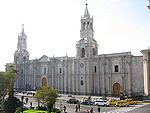
The "Casa del Moral" (House of the mulberry tree) is a large ancestral house built around 1730 in Arequipa, Peru. Favored by tourists, it is one of Peru's best and most well-preserved samples of Andean Baroque civil architecture. The name of the house derives from the emblematic presence of a centennial tree of "moras" (Mulberry) in the center of the main patio of the large house. The Casa del Moral houses a collection of paintings from the "Escuela Cusqueña" (Cusco School), a colonial art form. Its library contains more than 3,000 volumes, primarily hispanic literature. The house is currently the property of the Peruvian bank Bancosur.

Excerpt from the Wikipedia article Casa del Moral (License: CC BY-SA 3.0, Authors, Images).

Casa del Moral
Calle Moral, Arequipa

Geographical coordinates (GPS) Address Phone number Nearby Places
placeShow on map

Wikipedia: Casa del MoralContinue reading on Wikipedia

Geographical coordinates (GPS)

Latitude Longitude
N -16.396944444444 ° E -71.537777777778 °
placeShow on map

Address

Casa de Moral

Calle Moral 308
04020 Arequipa
Arequipa, Peru
mapOpen on Google Maps

Phone number

call+5154210084

Casa del Moral 2009
Casa del Moral 2009
Share experience

Nearby Places

Arequipa
Arequipa

Arequipa (Spanish pronunciation: [aɾeˈkipa]; Aymara and Quechua: Ariqipa) is a city in Peru and the capital of the eponymous province and department. It is the seat of the Constitutional Court of Peru and often dubbed the "legal capital of Peru". It is the second most populated city in Peru, after Lima, with an urban population of 1,296,278 inhabitants according to the 2017 national census.Its metropolitan area integrates twenty-one districts, including the foundational central area, which it is the seat of the city government. The city had a nominal GDP of US$9,445 million, equivalent to US$10,277 per capita (US$18,610 per capita PPP) in 2015, making Arequipa the city with the second-highest economic activity in Peru.Arequipa is also an important industrial and commercial center of Peru, and is considered as the second industrial city of the country. Within its industrial activity the manufactured products and the textile production of wool of camelids. The town maintains close commercial links with Chile, Bolivia, and Brazil and with the cities connected by the South trainway, as well as with the port of Matarani.The city was founded on 15 August 1540, under the name of "Beautiful Villa of Our Lady of the Assumption" in the name of Marquis Francisco Pizarro. On 22 September 1541, the monarch Carlos V ordered that it should be called the "City of Arequipa". During the viceregal period, it acquired importance for its outstanding economic role, and is characterized by the fidelismo towards the Spanish Crown, which honored Arequipa with titles such as "Very Noble and Very Loyal". In the Republican history of Peru, the city has been the focus of popular, civic and democratic rebellions. It has also been the cradle of notable intellectual, political and religious figures. In the Republican era, it was awarded the title of "Heroic city of the free people of Arequipa".Its historical center extends over an area of 332 hectares and has been declared a UNESCO World Heritage Site. Historical heritage and monumental that it houses and its diverse scenic and cultural spaces turn it into a host city of national and international tourism, in its historical center it highlights the religious architecture viceregal and republican product of mixture of Spanish and autochthonous characteristics, that constituted an own stylistic school called "Arequipeña School" whose influence arrived in Potosí (Bolivia).