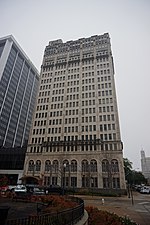
Jackson, officially the City of Jackson, is the capital of and the most populous city in the U.S. state of Mississippi. The city is also one of two county seats of Hinds County, along with Raymond. The city had a population of 153,701 at the 2020 census, down from 173,514 at the 2010 census. Jackson's population declined more between 2010 and 2020 (11.42%) than any major city in the United States. Jackson is the anchor for the Jackson metropolitan statistical area, the largest metropolitan area completely within the state and the 10th largest urban area in the Deep South. With a 2020 population estimated around 600,000, metropolitan Jackson is home to over one-fifth of Mississippi's population. The city sits on the Pearl River and is located in the greater Jackson Prairie region of Mississippi.
Founded in 1821 as the site for a new state capital, the city is named after General Andrew Jackson, who was honored for his role in the Battle of New Orleans during the War of 1812 and later served as U.S. president. Following the nearby Battle of Vicksburg in 1863 during the American Civil War, Union forces under the command of General William Tecumseh Sherman began the siege of Jackson and the city was subsequently burned.During the 1920s, Jackson surpassed Meridian to become the most populous city in the state following a speculative natural gas boom in the region. The current slogan for the city is "The City with Soul". It has had numerous musicians prominent in blues, gospel, folk, and jazz. The city is located in the deep south halfway between Memphis and New Orleans on Interstate 55 and Dallas and Atlanta on Interstate 20. Being at this location has given the city the nickname the "crossroads of the south".
The city has a number of museums and cultural institutions, including the Mississippi Children's Museum, Mississippi Museum of Natural Science, Mississippi Civil Rights Museum, Mississippi Museum of Art, Old Capital Museum, Museum of Mississippi History. Other notable locations are the Mississippi Coliseum and the Mississippi Veterans Memorial Stadium, home of the Jackson State Tigers Football Team.
The Jackson metropolitan statistical area is the state's second largest metropolitan area overall, due to four counties in northern Mississippi being part of the Memphis, Tennessee metropolitan area. In 2020, the Jackson metropolitan area held a GDP of 30 billion dollars, accounting for 29% of the state's total GDP of 104.1 billion dollars.

 Continue reading on Wikipedia