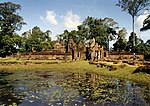
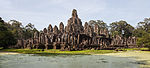
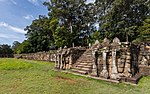
The Khmer Empire was a Hindu-Buddhist empire in Southeast Asia, centered around hydraulic cities in what is now northern Cambodia. Known as Kambuja by its inhabitants, it grew out of the former civilisation of Chenla and lasted from 802 to 1431. Historians call this period of Cambodian history the Angkor period, after the empire's most well-known capital, Angkor. The Khmer Empire ruled or vassalised most of mainland Southeast Asia and stretched as far north as southern China. At its peak, the Empire was larger than the Byzantine Empire, which existed around the same time.The beginning of the Khmer Empire is conventionally dated to 802, when Khmer prince Jayavarman II declared himself chakravartin (lit. 'universal ruler', a title equivalent to 'emperor') in the Phnom Kulen mountains. Although the end of the Khmer Empire has traditionally been marked with the Fall of Angkor to the Siamese Ayutthaya Kingdom in 1431, the reasons for the empire's collapse are still debated amongst scholars. Researchers have determined that a period of strong monsoon rains was followed by a severe drought in the region, which caused damage to the empire's hydraulic infrastructure. Variability between droughts and flooding was also a problem, which may have caused residents to migrate southward and away from the empire's major cities.The site of Angkor is perhaps the empire's most notable legacy, as it was the capital during the empire's zenith. The majestic monuments of Angkor, such as Angkor Wat and Bayon, bear testimony to the Khmer Empire's immense power and wealth, impressive art and culture, architectural technique, aesthetic achievements, and variety of belief systems that it patronised over time. Satellite imaging has revealed that Angkor, during its peak in the 11th to the 13th centuries, was the most extensive pre-industrial urban complex in the world. Researchers have also concluded that the Khmer Empire invented the world's first healthcare system, which included 102 hospitals.

 Continue reading on Wikipedia