place

Memphis Zoo

1906 establishments in TennesseeBuildings and structures in Memphis, TennesseeCulture of Memphis, TennesseeTourist attractions in Memphis, TennesseeZoos established in 1906
Zoos in Tennessee
MemphisZooentrance
MemphisZooentrance

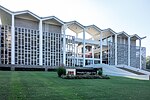
The Memphis Zoo is a zoo in Midtown, Memphis, Tennessee, United States. It is home to more than 3,500 animals representing over 500 different species. Created in April 1906, the zoo has been a major tenant of Overton Park for more than 100 years. The land currently designated to the Memphis Zoo was defined by the Overton Park master plan in 1888, it is owned by the City of Memphis. The zoo is set on 76 acres (31 ha), of which approximately 55 acres (22 ha) are developed. In 2008, the Memphis Zoo was ranked "#1 Zoo in the U.S." by TripAdvisor. The ranking was based on visitor opinions.Since the early 1990s, the Memphis Zoo has invested over $77 million for renovation and expansion. The zoo's animal inhabitants reside in three zones with 19 exhibits, such as Teton Trek, Northwest Passage and China, home to giant pandas Ya Ya and Le LeThe Memphis Zoo is an accredited member of the Association of Zoos and Aquariums (AZA).

Excerpt from the Wikipedia article Memphis Zoo (License: CC BY-SA 3.0, Authors, Images).

Memphis Zoo
University Street, Memphis

Geographical coordinates (GPS) Address Website External links Nearby Places
placeShow on map

Wikipedia: Memphis ZooContinue reading on Wikipedia

Geographical coordinates (GPS)

Latitude Longitude
N 35.15 ° E -89.9943 °
placeShow on map

Address

Memphis Zoo

University Street 2000
38112 Memphis
Tennessee, United States
mapOpen on Google Maps

Website
memphiszoo.org

linkVisit website

linkWikiData (Q6815902)
linkOpenStreetMap (11810360)

MemphisZooentrance
MemphisZooentrance
Share experience

Nearby Places

Overton Park Shell
Overton Park Shell

The Overton Park Shell (formerly Levitt Shell, Shell Theater, and Memphis Open Air Theater) is an open-air amphitheater located in Overton Park, Memphis, Tennessee. Elvis Presley gave his first paid concert there on July 30, 1954. The Overton Park Shell was built in 1936 by the City of Memphis and the Works Progress Administration for $11,935, as part of the New Deal. Designed by architect Max Furbringer, it was modeled after similar shells in Chicago, New York, and St. Louis. The WPA built 27 band shells, the Overton Park Shell is one of only a few that still remain. During the 1930s and 1940s, the Shell was the site of Memphis Open Air Theater orchestral shows, along with various light opera and musicals. However, on July 30, 1954, Elvis Presley opened for headliner Slim Whitman, and performed what music historians call the first-ever rock and roll show. In the mid-1960s, the Shell was turned over to the Memphis Arts Center, who planned to raze it in order to build a $2 million theater. However, a campaign led by Noel Gilbert, long-time conductor of the Memphis Concert Orchestra, gathered 6,000 signatures in order to prevent its destruction. Later, in 1972, the Shell was nearly removed in order to build a parking garage, but was again saved by the outcry from the community. In 1982, the National Conference of Christians and Jews proposed a restoration, and the Shell was renamed in honor of Raoul Wallenberg. However, they could not raise the necessary funds, so by 1984, the previous plan for a parking lot began once again. This time, the Shell was saved by Mayor Richard Hackett. He pledged to fund a renovation if a private group would spearhead an arts program. In 1985, the Shell lay dormant for the first time in its history. In 1986, a corporation was formed by private citizens named Save Our Shell, Inc. For the following 20 years, Save Our Shell presented hundreds of free programs there. In 2007, the Shell was renamed Levitt Shell at Overton Park and a large-scale renovation funded by the Levitt Foundation took place. The renovation was conducted by Memphis firm Askew Nixon Ferguson Architects with state-of-the-art audio and visual design. With the completion of the renovations on September 8, 2008, free concerts are now once again held in the Shell. The Shell offers concerts on Thursday, Friday, Saturday, and Sunday nights during its spring and fall seasons. In the summer of 2011, Indie Memphis debuted The Concert Film Series, presenting free concert films for the public on weekends during the summer months.On March 3, 2022, the Levitt Shell was renamed back to its historic name of the Overton Park Shell, continuing its mission of free music under the stars for the entire community.

Vollintine Hills Historic District

Vollintine Hills Historic District is a historic district located in the Midtown area of Memphis, Tennessee, notable for its cohesive collection of 78 post-World War II Minimal Traditional and ranch-style houses built around a former synagogue. "The neighborhood represents the efforts of members of an Orthodox religious group to accommodate their beliefs by developing a synagogue and housing for the congregation within easy walking distance."Added to the National Register of Historic Places in 2007, the area also includes the former site of the Baron Hirsch Synagogue, built in two phases—1950-52 and 1955-57—in the International Style and set on a 12.4-acre (50,000 m2) site at the southwest corner of the district.When it was completed in 1957, the main sanctuary of the synagogue was the largest in the United States, according to the Union of Orthodox Jewish Congregations of America.Houses within the district are largely "intact and homogeneous building stock constructed between 1946–1957" in conjunction with the synagogue, and are within walking distance of the former synagogue. They originally served to house its orthodox Jewish congregation." The district has been singled out for its unity by both "its historic building stock and contiguity to the former synagogue."Vollintine Hills is notable as a clearly definable geographic area, whose physical development, "defined by the needs of a religious community," is "readily distinguishable from surrounding properties."Although the synagogue was vacated in 1984 and moved to a new location farther east in Memphis, the original building still stands and in 1992 was sold by the congregation to the Gethsemane Garden Church of God in Christ. The historic area "continues to be a viable area today, adapting to changing times and needs."Vollintine Hills is located approximately four miles east of the downtown Memphis central building district in the northern section of the Midtown area, and is roughly bounded by Vollintine Avenue, Brown Avenue, McLean Boulevard, and Evergreen Street.