place

Park Center Sofia

Buildings and structures completed in 2006Shopping malls established in 2006Shopping malls in Sofia

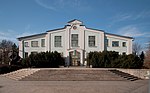
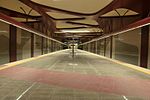
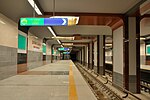
Park Center Sofia, formerly City Center Sofia, is a shopping mall located in Sofia, Bulgaria, opened in the spring of 2006. It is south of the National Palace of Culture in the municipality of Triaditsa at the intersection of the Boulevards "Cherni vrah" and "Arsenalski", next to European Union Metro Station and diagonally opposed to the Hemus Hotel. The mall has six stories (including two underground) and a total built-up area of 44,000 m2 (470,000 sq ft) (23,000 m2 (250,000 sq ft) for the commercial area). There are more than 100 stores, several cafés, a pharmacy, beauty parlors, bank offices and parking lots. There are also two hypermarkets presented in the mall: Technomarket and Picadilly. The cinema complex Cine Grand has six halls with a total capacity of 1,340 seats.

Excerpt from the Wikipedia article Park Center Sofia (License: CC BY-SA 3.0, Authors).

Park Center Sofia
bul. Arsenalski, Sofia ж.к. Лозенец (Triadica)

Geographical coordinates (GPS) Address Website External links Nearby Places
placeShow on map

Wikipedia: Park Center SofiaContinue reading on Wikipedia

Geographical coordinates (GPS)

Latitude Longitude
N 42.678611111111 ° E 23.320555555556 °
placeShow on map

Address

Мол Парк Център София

bul. Arsenalski 2
1421 Sofia, ж.к. Лозенец (Triadica)
Bulgaria
mapOpen on Google Maps

Website
parkcenter.bg

linkVisit website

linkWikiData (Q3656933)
linkOpenStreetMap (96425745)

Share experience

Nearby Places

Bulgaria
Bulgaria

Bulgaria ( (listen); Bulgarian: България, romanized: Bǎlgariya), officially the Republic of Bulgaria, is a country in Southeast Europe. It occupies the whole eastern part of the Balkans, and is bordered by Romania to the north, Serbia and North Macedonia to the west, Greece and Turkey to the south, and the Black Sea to the east. Bulgaria covers a territory of 110,994 square kilometres (42,855 sq mi), and is the sixteenth-largest country in Europe. Sofia is the nation's capital and largest city; other major cities are Plovdiv, Varna and Burgas. One of the earliest societies in the lands of modern-day Bulgaria was the Neolithic Karanovo culture, which dates back to 6,500 BC. In the 6th to 3rd century BC the region was a battleground for ancient Thracians, Persians, Celts and Macedonians; stability came when the Roman Empire conquered the region in AD 45. After the Roman state splintered, tribal invasions in the region resumed. Around the 6th century, these territories were settled by the early Slavs. The Bulgars led by Asparuh of Bulgaria attacked from the lands of (Old Great) Bulgaria and permanently invaded the Balkans in the late 7th century. They established (Danubian) Bulgaria, victoriously recognised by treaty in AD 681 by the Eastern Roman Empire. It dominated most of the Balkans and significantly influenced Slavic cultures by developing the Cyrillic script. The First Bulgarian Empire lasted until the early 11th century, when Byzantine emperor Basil II conquered and dismantled it. A successful Bulgarian revolt in 1185 established a Second Bulgarian Empire, which reached its apex under Ivan Asen II (1218–1241). After numerous exhausting wars and feudal strife, the empire disintegrated in 1396 and fell under Ottoman rule for nearly five centuries. The Russo-Turkish War of 1877–78 resulted in the formation of the third and current Bulgarian state. Many ethnic Bulgarians were left outside the new nation's borders, which stoked irredentist sentiments that led to several conflicts with its neighbours and alliances with Germany in both world wars. In 1946, Bulgaria came under the Soviet-led Eastern Bloc and became a socialist state. The ruling Communist Party gave up its monopoly on power after the revolutions of 1989 and allowed multiparty elections. Bulgaria then transitioned into a democracy and a market-based economy. Since adopting a democratic constitution in 1991, Bulgaria has been a unitary parliamentary republic composed of 28 provinces, with a high degree of political, administrative, and economic centralisation. Bulgaria is a developing country, with an upper-middle-income economy, ranking 56th in the Human Development Index. Its market economy is part of the European Single Market and is largely based on services, followed by industry—especially machine building and mining—and agriculture. Widespread corruption is a major socioeconomic issue; Bulgaria ranked as the most corrupt country in the European Union in 2018. The country also faces a demographic crisis, with its population shrinking annually since around 1990; it currently numbers roughly seven million, down from a peak of nearly nine million in 1988. Bulgaria is a member of the European Union, NATO, and the Council of Europe; it is also a founding member of the OSCE, and has taken a seat on the United Nations Security Council three times.

National Palace of Culture

The National Palace of Culture (Национален дворец на културата, Natsionalen dvorets na kulturata; abbreviated as НДК, NDK), located in Sofia, the capital of Bulgaria, is the largest, multifunctional conference and exhibition centre in south-eastern Europe. It was opened in 1981 in celebration of Bulgaria's 1300th anniversary. The centre was initiated at the suggestion of Lyudmila Zhivkova, daughter of the communist leader of the former People's Republic of Bulgaria Todor Zhivkov. The project was designed by a team of Bulgarian and foreign architects led by Alexander Georgiev Barov (1931–1999) along with Ivan Kanazirev. The landscaping of Bulgaria Square in front of the National Palace of Culture was designed by another team of architects and landscape engineers, led by Atanas Agura. Internally, the building exhibits a unified style, employing an octagonal motif and heavy, dark colours. Large bright murals depicting historical figures and events cover the main wall of many of the smaller halls. During the 1990s, immediately following the change of the political model in the country, the NDK lost a significant portion of its property, including infrastructure, commercial areas, and car parks. Since 2011, the NDK has been restructured into a commercial company, but it remains a state property. It is self-sustaining, receiving no subsidies. The first public financial report of the Palace was released in 2012. A substantial part of the revenues are invested annually in new projects and its own cultural events. The Festival and Congress Centre (FCC) is the Varna branch of the NDK. It was founded in 1986 and it is gradually becoming the center of some of the most prestigious events in the field of art and culture. FCC is host to artistic events and festivals, scientific meetings, seminars, and more. FCC is the face of Bulgaria when it comes to prestigious international congress organizations such as ICCA, EFCT, AIPC and it is included in the only pan-European network of cinemas, Europe Cinema, in the European Union (EU). In July 2005, the National Palace of Culture was proclaimed the best congress centre in the world for the year by the International Organization of Congress Centres.The conference centre is equipped to host a variety of events, including concerts, multilingual conferences, exhibitions, and shows. It has an area of 123,000 square meters on eight floors and three underground levels. The National Palace of Culture has 13 halls and 15,000 square meters of exhibition area, a trade centre and a car park. The main hall can seat over 3,000 people. The Sofia International Film Festival takes place in the NDK.