place

FC Ferizaj

1923 establishments in YugoslaviaAssociation football clubs established in 1923European football club stubsFootball clubs in KosovoFootball clubs in Yugoslavia
KF FerizajKosovan sport stubs

Football Club Ferizaj (Albanian: Klubi Futbollistik Ferizaj), commonly known as Ferizaj, is a professional football club based in Ferizaj, Kosovo. The club plays in the Football Superleague of Kosovo, which is the first tier of football in the country.

Excerpt from the Wikipedia article FC Ferizaj (License: CC BY-SA 3.0, Authors).

FC Ferizaj
Mullini Kukës, Ferizaj Varosht

Geographical coordinates (GPS) Address Nearby Places
placeShow on map

Wikipedia: FC FerizajContinue reading on Wikipedia

Geographical coordinates (GPS)

Latitude Longitude
N 42.37449 ° E 21.137202 °
placeShow on map

Address

Mullini Kukës
27000 Ferizaj, Varosht
Kosovo
mapOpen on Google Maps

Share experience

Nearby Places

St. Uroš Cathedral, Ferizaj

The Church of the Holy Emperor Uroš (Serbian: црква Светог Цара Уроша; Albanian: Kisha e Ëngjëlli i Rojës) is a Serbian Orthodox church located in the center of Ferizaj (also known by the Serbian population as Uroševac) in Kosovo. It belongs to the Eparchy of Raška and Prizren. The church was built between 1929 and 1933, dedicated to Serbian emperor Uroš V (r. 1355–71). Its architect was Josif Mihajlović Jurukovski from Skopje. It was built as a five-domed building with a trefoil base, and made of concrete, stone and brick mix which was later plastered. The church of the Gračanica monastery served as a model for the diverse composition of the upper part of the temple. The decoration in the dome consists of chess box with crosses, floral motifs and bricks. The main dome rests on four free pillars. The murals were painted by Janko Kuzmanović from Galičnik, from 1932–36, who, along with Viktorija Puzanova from Mitrovica, created the throne icons and richly carved iconostasis decorations. The collection of Serbian medieval iconography, including the icon of the Holy Trinity, painted by Josif Radević from Lazaropolje in 1896. The iconostasis is from the 19th century, made in wood, and it was a gift of the Serbian King Aleksandar I Karađorđević.The church was looted and set on fire by Albanians after the arrival of the US KFOR forces in town, at the end of June 1999. It was attacked in the 2004 unrest, and Albanian nationalist graffiti were painted on the walls in 2013.In 2015 work on the exterior began. In September 2016, more than 200 Serb former inhabitants of the town (pre-war 12,000 Serbs, now only three), participated in liturgy in the church.

Nikadin (archaeological site)

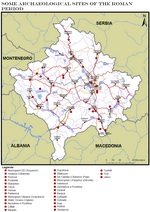
Part of a series of articles upon Archaeology of Kosovo The village of Nikadin (Nicodemus), nowadays a suburban part of the town of Ferizaj, is situated only 2 kilometers south from the town, sited in a spacious and fertile countryside. During the 1960s, superficial traces of a Roman villa complex have been recorded here. Nevertheless, during gardening carried out in front of a house, accidentally a remarkable sarcophagus lid was unearthed, a rare and unique for the region of Kosovo. A sarcophagus is a funeral receptacle for a corpse, most commonly carved from marble or limestone. The sarcophagus lid discovered here is carved in marbled limestone in the shape of a house roof and decorated on the sides with anthropomorphic human bust, while on the front of the lid, decorated with floral motifs. The sarcophagus lid was carved during the end of the 3rd or the beginning of the 4th century AD. The accidental discovery of the lid, lead towards the rescue excavation investigation (2007) carried out in form of trial trenches. The results of this archaeological research were unexpected, while a small unknown early Christian church (4th -6th century AD) was unearthed (though very damaged). Taking into account that, the church was constructed by stones bonded with lime mortar, but the most interesting discoveries were the spolia (the re-use of earlier building material or decorative sculpture on new monuments) of the Roman date.