place

Memorial Tower

1926 establishments in LouisianaBaton Rouge, Louisiana building and structure stubsBell towers in the United StatesClock towers in LouisianaHistoric district contributing properties
Louisiana State University buildings and structuresMonuments and memorials in LouisianaTowers completed in 1926Use mdy dates from December 2019
LSU Memorial Tower 2

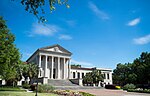
Memorial Tower, or the Campanile as it is sometimes called, is a 175-foot clock tower in the center of Louisiana State University's campus in Baton Rouge, Louisiana, United States. Erected in 1923 and officially dedicated in 1926, it stands as a memorial to Louisianans who died in World War I.

Excerpt from the Wikipedia article Memorial Tower (License: CC BY-SA 3.0, Authors, Images).

Memorial Tower
Tower Drive, Baton Rouge

Geographical coordinates (GPS) Address External links Nearby Places
placeShow on map

Wikipedia: Memorial TowerContinue reading on Wikipedia

Geographical coordinates (GPS)

Latitude Longitude
N 30.41447 ° E -91.1789 °
placeShow on map

Address

Tower Drive
70803 Baton Rouge
Louisiana, United States
mapOpen on Google Maps

linkWikiData (Q6815533)
linkOpenStreetMap (550888707)

LSU Memorial Tower 2
Share experience

Nearby Places

Louisiana State University

Louisiana State University (officially Louisiana State University and Agricultural and Mechanical College, commonly referred to as LSU) is an American public land-grant research university in Baton Rouge, Louisiana. The university was founded in 1860 near Pineville, Louisiana, under the name Louisiana State Seminary of Learning & Military Academy. The current LSU main campus was dedicated in 1926, consists of more than 250 buildings constructed in the style of Italian Renaissance architect Andrea Palladio, and the main campus historic district occupies a 650-acre (260 ha) plateau on the banks of the Mississippi River. LSU is the flagship university of the state of Louisiana, as well as the flagship institution of the Louisiana State University System. In 2021, the university enrolled over 28,000 undergraduate and more than 4,500 graduate students in 14 schools and colleges. It is classified among "R1: Doctoral Universities – Very high research activity". LSU operates some 800 sponsored research projects funded by agencies such as the National Institutes of Health, the National Science Foundation, the National Endowment for the Humanities, and the National Aeronautics and Space Administration. LSU is one of eight universities in the United States with dental, law, veterinary, medical, and Master of Business Administration programs.LSU's athletics department fields teams in 21 varsity sports (nine men's, 12 women's), and is a member of the NCAA (National Collegiate Athletic Association) and the SEC (Southeastern Conference). The university is represented by its mascot, Mike the Tiger.

Paul M. Hebert Law Center

The Paul M. Hebert Law Center, often styled "LSU Law", is a public law school in Baton Rouge, Louisiana. It is part of the Louisiana State University System and located on the main campus of Louisiana State University. Because Louisiana is a civil law state, unlike its 49 common law sister states, the curriculum includes both civil law and common law courses, requiring 94 hours for graduation, the most in the United States. In the Fall of 2002, the LSU Law Center became the sole United States law school, and only one of two law schools in the Western Hemisphere, offering a course of study leading to the simultaneous conferring of a J.D. (Juris Doctor), which is the normal first degree in American law schools, and a D.C.L. (Diploma in Comparative Law), which recognizes the training its students receive in both the common and the civil law. Until voting in April 2015 to realign itself as an academic unit of Louisiana State University, the Paul M. Hebert Law Center was an autonomous school. Its designation as a Law Center, rather than Law School, derives not only from its formerly independent campus status but also from the centralization on its campus of J.D. and post-J.D. programs, foreign and graduate programs, including European programs at the Jean Moulin University Lyon 3 School of Law, France, and the University of Louvain, Belgium, and the direction of the Louisiana Law Institute and the Louisiana Judicial College, among other initiatives. According to the school's 2017 ABA-required disclosures, 81.3% of the Class of 2017 obtained full-time, long-term, bar passage-required employment nine months after graduation, excluding solo practitioners.