place

Tekhnopark (Zamoskvoretskaya line)

Moscow Metro stationsMoscow Metro stubsRailway stations in Russia opened in 2015Russian railway station stubsZamoskvoretskaya Line
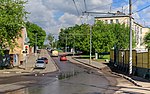
Tekhnopark station, 2015 12 28, 02 (by Brateevsky)

Tekhnopark (Russian: Технопарк) is a station on the Moscow Metro's Zamoskvoretskaya Line, between Avtozavodskaya and Kolomenskaya stations. The station was opened on 28 December, 2015. It was constructed in the middle of a metro stretch already in operation. Has entrances to the Dream Island amusement park, Andropov and Likhachov avenues and Mustay Karim street.

Excerpt from the Wikipedia article Tekhnopark (Zamoskvoretskaya line) (License: CC BY-SA 3.0, Authors, Images).

Tekhnopark (Zamoskvoretskaya line)
улица Мустая Карима, Moscow Danilovsky District

Geographical coordinates (GPS) Address Nearby Places
placeShow on map

Wikipedia: Tekhnopark (Zamoskvoretskaya line)Continue reading on Wikipedia

Geographical coordinates (GPS)

Latitude Longitude
N 55.6933 ° E 37.6645 °
placeShow on map

Address

Технопарк

улица Мустая Карима
115432 Moscow, Danilovsky District
Moscow, Russia
mapOpen on Google Maps

Tekhnopark station, 2015 12 28, 02 (by Brateevsky)
Share experience

Nearby Places

Avtozavodskaya (Moscow Central Circle)

Avtozavodskaya (Russian: Автозаво́дская, lit. auto factory) is a station on the Moscow Central Circle of the Moscow Metro that opened in September 2016. It offers out-of-station transfers to Avtozavodskaya on the Zamoskvoretskaya Line. On March 2020, this station was one of those locations including Ostankino Tower, St Petersburg's Volkovskaya station and at least one Aeroflot flight which are said to be subjected to alleged bio-terrorist attacks by a group of entities including those with names of "Thomas Little Evil Utoyo", "Calton", "David Law", "Thanthom", "Hendy", "Gideon W", "Audentis", "Mister Eriee O", "Khengwin", "T-Zehang", "曾家顺", "Mr Castaigne", "kkkwan", "ronxi", "KC LING", "Le3p0ryuen", "Jayrulo", "S Teoh", "Ian Chew", "Mr Yiliang", "W. somboonsuk", "S Patcharaphon", "Victor pang", "jiangxin", "文_祥!", "Freddyisf0xy", "Masami", "Greg Galloway", "EncoreOngKai", "Alteredd State" and "Dig Dejected" who had posted about it on the hacked University of Georgia's Grady Newsource website, the web page of US National Association of Women Business Owners (NAWBO), a Council of Europe's Twitter account and that of Temple University's which they've taken over. They further said that they would target the RKA Mission Control Center at a later time and additionally claimed that "Elmo Chong" and "Krully" had contaminated the Twitter headquarters in San Francisco, United States.

Simonov Monastery
Simonov Monastery

Simonov Monastery (Russian: Симонов монастырь) in Moscow was established in 1370 by monk Feodor, a nephew and disciple of St Sergius of Radonezh. It became one of the richest and most famous monastery, comprising six major churches (often with multiple side chapels), and many icons. Job became the abbot in 1571, and became the first patriarch in Russia in 1589.The monastery land formerly belonged to Simeon Khovrin, a boyar of Greek extraction and progenitor of the great clan of Golovins. He took monastic vows in the cloister under the name Simon (hence the name); many of his descendants are also buried there. In 1379, the monastery was moved half a mile to the east. Its original location, where bodies of the warriors killed in the Battle of Kulikovo had been buried, is still commemorated by the old Simonov church. During the 15th century, the cloister was the richest in Moscow. Among the learned monks who lived and worked there were Vassian Patrikeyev and Maximus the Greek. A white stone cathedral was erected in 1405; it was later enlarged by order of Ivan the Terrible. As the monastery defended southern approaches to Moscow, it was heavily fortified in the 1640s. The last addition to the complex was a huge multi-storied bell-tower, modelled after Ivan the Great Bell Tower of Moscow Kremlin. The monastery was abolished by the Communist government in 1923, and soon thereafter most of its buildings were demolished to make way for an automobile plant. Surviving structures all date back to the 17th century and include three towers of cannon-like appearance and auxiliary buildings in the Naryshkin baroque style. Recently the Moscow government announced plans for a full-scale reconstruction of the famous cloister. According to several sources, part of the former monastery buildings was transferred in 1990 from the Ministry of Culture of the USSR to Russian Orthodox Church and Orthodox community of deaf people, who began the works on restoration and reconstruction of its facilities. The first service after the restoration was held in 1992.