place

Riga Technical University

1862 establishments in the Russian EmpireEducational institutions established in 1862Riga Technical UniversityUniversities in Latvia
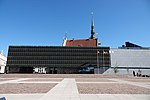
Riga Zunds and RTU (34183652963)

Riga Technical University (RTU) (Latvian: Rīgas Tehniskā universitāte) is the oldest technical university in the Baltic countries established on October 14, 1862. It is located in Riga, Latvia and was previously known as 'Riga Polytechnical Institute' and 'Riga Polytechnicum'. In 1958, the Riga Polytechnic Institute was established as a separate institution, separating the departments of engineering from the Latvian State University. Over the years, the Riga Polytechnic Institute evolved and expanded its academic offerings, becoming one of the leading technical universities in the region. In 1990, it was renamed Riga Technical University (RTU), and today, it has nine faculties and is the largest STEM oriented university in Latvia. In the 2022 QS EECA university rankings, RTU was ranked 57th among the universities in Eastern Europe and Central Asia.

Excerpt from the Wikipedia article Riga Technical University (License: CC BY-SA 3.0, Authors, Images).

Riga Technical University
Kaļķu iela, Riga Old Riga

Geographical coordinates (GPS) Address Nearby Places
placeShow on map

Wikipedia: Riga Technical UniversityContinue reading on Wikipedia

Geographical coordinates (GPS)

Latitude Longitude
N 56.9472 ° E 24.1047 °
placeShow on map

Address

Kaļķu iela 1
LV-1050 Riga, Old Riga
Vidzeme, Latvia
mapOpen on Google Maps

Riga Zunds and RTU (34183652963)
Share experience

Nearby Places

House of the Blackheads (Riga)

The House of the Blackheads (Latvian: Melngalvju nams, German: Schwarzhäupterhaus) is a building situated in the old town of Riga, Latvia. The original building was erected during the first third of the 14th century for the Brotherhood of Blackheads, a guild for unmarried merchants, shipowners, and foreigners in Riga. Major works were done in the early 17th century, adding most of the Mannerist ornamentation. The sculptures were made by the workshop of August Volz. Additionally, it is the site of the first decorated Christmas tree, which was erected in 1510. The building was bombed to a ruin by the Germans on June 28, 1941 — a week after the launching of Operation Barbarossa — and the remains were demolished by the Soviets in 1948. It was rebuilt between 1996 and 1999 with funds provided by Valērijs Kargins, the president of Parex Bank. Part of the funds donated were from all the people who wanted to participate in the rebuilding process, by joining in the event ''I build the House of the Black Heads'', where by donating 5 lats (approximately 7-11 EUR) they could symbolically put a brick on the wall. There were more than 5,000 participants. The House of the Black Heads was officially opened on December 9, 1999. Today the House of the Blackheads is a museum. In the upper level are located grand ballrooms, where historically many luxurious events happened — welcoming ceremonies for kings, queens, presidents, and also many cultural events — balls, classical music concerts, theatre performances, and operas with many world famous guest-stars. On another floor it is possible to visit the historic cabinets — a temporary work-space for the President of Latvia, who moved the Presidential residence to the House of the Blackheads from 2012 to 2016, while the permanent location in Riga Castle was under reconstruction. The historical cellar is the only original part of the building which survived World War II and during the Soviet Occupation. Until the early 1990s it was buried underground and not visible. The historic cellar is one of the few places where it is possible to walk through an authentic underground of Old Riga, where the remains — wall fragments, floor and even the wooden stairs are original, and some of that is dated as far back as the 14th century. This was former storage for goods and part of it was space for a hypocaust or warm air furnace. Today there are interesting, interactive exhibitions relating to commerce in Riga and the history of the Brotherhood of Blackheads.

Riga
Riga

Riga (; Latvian: Rīga [ˈriːɡa] (listen), Livonian: Rīgõ) is the capital and largest city of Latvia and is largest city in the Baltic states,and is home to 605,802 inhabitants which is a third of Latvia's population. The population of Rigas functional urban area, which stretches beyond the city limits, is estimated at 920,643 (as of 2023). The city lies on the Gulf of Riga at the mouth of the Daugava river where it meets the Baltic Sea. Riga's territory covers 307.17 km2 (118.60 sq mi) and lies 1–10 m (3.3–32.8 ft) above sea level, on a flat and sandy plain.Riga was founded in 1201 and is a former Hanseatic League member. Riga's historical centre is a UNESCO World Heritage Site, noted for its Art Nouveau/Jugendstil architecture and 19th century wooden architecture. Riga was the European Capital of Culture in 2014, along with Umeå in Sweden. Riga hosted the 2006 NATO Summit, the Eurovision Song Contest 2003, the 2006 IIHF Men's World Ice Hockey Championships, 2013 World Women's Curling Championship and the 2021 IIHF World Championship. It is home to the European Union's office of European Regulators for Electronic Communications (BEREC). In 2017, it was named the European Region of Gastronomy. In 2019, Riga received over 1.4 million foreign visitors. The city is served by Riga International Airport, the largest and busiest airport in the Baltic states. Riga is a member of Eurocities, the Union of the Baltic Cities (UBC) and Union of Capitals of the European Union (UCEU).

Eurovision Song Contest 2003

The Eurovision Song Contest 2003 was the 48th edition of the Eurovision Song Contest. It took place in Riga, Latvia, following the country's victory at the 2002 contest with the song "I Wanna" by Marie N. Organised by the European Broadcasting Union (EBU) and host broadcaster Latvijas Televīzija (LTV), the contest was held at the Skonto Hall on 24 May 2003. The contest was presented by last year's winner Marie N and former contestant Renārs Kaupers.Twenty-six countries participated in the contest, beating the record of twenty-five first set in 1993. It saw the return of Iceland, Ireland, the Netherlands, Norway and Poland after having been relegated from competing the previous year. Portugal also returned to the contest after being absent the previous year, while Ukraine participated in the contest for the first time. Denmark, Finland, Lithuania, Macedonia and Switzerland were relegated due to their poor results in 2002. The winner was Turkey with the song "Everyway That I Can", performed by Sertab Erener who wrote it with Demir Demirkan. This was Turkey's first victory in the contest after 28 years of participation. Belgium, Russia, Norway and Sweden rounded out the top five. Further down the table, the United Kingdom achieved their worst result to date, finishing twenty-sixth (last place) with no points. However, they avoided relegation due to being one of the "Big Four" countries at the time. The host country Latvia placed twenty-fourth (third from last) – this was the first time since 1995 that the host entry did not place in the top 10, and it was, overall, the worst result for a host entry since 1992. This was the last contest to take place on one evening. The EBU revealed that it would be adding a semi-final show to the competition in order to accommodate the growing number of interested countries wishing to take part in the contest. This was also the last contest in which a relegation system was used to determine which countries would participate in the following year's contest. As the Belgian entry was sung in an imaginary language, this was also the first time the contest featured a song with no parts performed in English or a language native to the country.