place

Queen Alexandra Hospital, Hobart

1902 establishments in Australia1980 disestablishments in AustraliaHospital buildings completed in 1980Hospitals established in 1902Hospitals in Hobart

The Queen Alexandra Hospital for Women was a maternity hospital and children hospital established at Hobart, Tasmania in 1905 to commemorate the coronation of King Edward VII and Queen Alexandra in 1902 on a site in Hampden Road, Battery Point.The hospital was primarily designed to care for women who were pregnant, in need of natal and neonatal care, and as a training hospital for midwives and nurses.It was originally operated by a private board of management, but in 1950 it came under the control of the Government of Tasmania, who increasingly affiliated its services with those of the Royal Hobart Hospital. In 1980, the building in Battery Point which was becoming too antiquated for modern health care services, was closed, and the Queen Alexandra hospital was moved to a new wing attached to the Royal. In 1999, the Queen Alexandra wing was closed and sold off to a private consortium, who re-opened the site as the Hobart Private Hospital. Hollywood actor Errol Flynn was born at the hospital in 1909. The perpetrator of the Port Arthur massacre was born at the hospital in May 1967., Mary Donaldson, Crown Princess Mary was born in Queen Alexandria Hospital on February 1972.

Excerpt from the Wikipedia article Queen Alexandra Hospital, Hobart (License: CC BY-SA 3.0, Authors).

Queen Alexandra Hospital, Hobart
Hampden Road, Hobart Battery Point

Geographical coordinates (GPS) Address Nearby Places
placeShow on map

Wikipedia: Queen Alexandra Hospital, HobartContinue reading on Wikipedia

Geographical coordinates (GPS)

Latitude Longitude
N -42.89 ° E 147.33122222222 °
placeShow on map

Address

Hampden Road 80-82
7004 Hobart, Battery Point
Tasmania, Australia
mapOpen on Google Maps

Share experience

Nearby Places

Battery Point, Tasmania

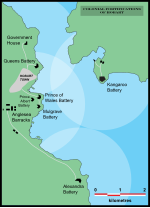
Battery Point is a suburb of the city of Hobart, Tasmania, Australia. It is immediately south of the central business district. It is in the local government area of City of Hobart. Battery Point is named after the battery of guns which were established on the point in 1818 as part of the Hobart coastal defences. The battery was situated on the site of today's Princes Park. The guns were used to fire salutes on ceremonial occasions but were never called upon to repel an invasion. The battery was decommissioned after an 1878 review of Hobart's defences found that its location would tend to draw an enemy's fire onto the surrounding residential neighbourhood. The site was subsequently handed over to the Hobart City Council as a place of recreation and amusement. When the Council carried out works to beautify the park in 1934, they discovered tunnels which had served as a magazine for the original battery. In 1973, a green ban was placed by the Builders Labourers Federation to prevent destruction of certain buildings by developers.The area is generally known as one of the city's more prestigious suburbs, with many large and extravagant homes and apartment blocks. It adjoins the waterfront Salamanca area as well as the nearby prestigious suburb of Sandy Bay. Probably the most significant is Arthur Circus with its cottages, mostly originally constructed for the officers of the garrison. Battery Point is accessible via Hampden Road, which runs from Sandy Bay Road from the edge of the city. Battery Point residents have been the centre of controversy in recent years, demanding noise restrictions and other measures aimed at safeguarding a sheltered lifestyle.

Hobart coastal defences

The Hobart coastal defences are a network of now defunct coastal batteries, some of which are inter-linked with tunnels, that were designed and built by British colonial authorities in the nineteenth century to protect the city of Hobart, Tasmania, from attack by enemy warships. During the nineteenth century, the port of Hobart Town was a vital re-supply stop for international shipping and trade, and therefore a major freight hub for the British Empire. As such, it was considered vital that the colony be protected. In all, between 1804 and 1942 there were 12 permanent defensive positions constructed in the Hobart region.Prior to Australian Federation, the island of Tasmania was a colony of the British Empire, and as such was often at war with Britain's enemies and European rivals, such as France and later Russia. The British had already established the colony of Sydney at Port Jackson in New South Wales in 1788, but soon began to consider the island of Tasmania as the potential site of a useful second colony. It was an island, cut off from the mainland of Australia and isolated geographically, making it ideal for a penal colony, and was rich in timber, a resource useful to the Royal Navy. In 1803, the British authorities decided to colonise Tasmania, and to establish a permanent settlement on the island that was at the time known as Van Diemen's Land, primarily to prevent the French from doing so. During this period tensions between Great Britain and France remained high. The two nations had been fighting the French Revolutionary Wars with each other through much of the 1790s, and would soon be engaging each other again in the Napoleonic Wars.The first permanent British settlement in Van Diemen's Land had begun on 8 September 1803, at Risdon Cove on the Derwent River's eastern shore. However, the arrival of Lieutenant-Governor David Collins on 16 February 1804, saw him make the decision to relocate the settlement to Sullivan's Cove on the western shore of the Derwent River. Within days of the settlement's establishment, Collins had decided the new colony would need protection should the French send warships up the river to threaten the fledgling colony. A crude earthwork redoubt was dug into an elevated position near the centre of Sullivan's Cove, in the area that is now Franklin Square, and two ships cannons were placed inside. For the next seven years, this muddy emplacement would serve as the only defensive position of what was growing to become Hobart Town.When Governor Lachlan Macquarie toured the Hobart Town settlement in 1811, he was alarmed at the poor state of the defences and the general disorganisation of the colony. Along with planning for a new grid pattern of streets to be laid out, and new administrative and other buildings to be built, he commissioned the building of Anglesea Barracks, which opened in 1814, and is now the oldest continually occupied barracks in Australia. Macquarie also suggested the construction of more permanent fortifications. Following his advice, a new location comprising an area of 8 acres (32,000 m2) was selected at the eastern end of Battery Point on the southern side of Sullivan's Cove, and construction began on what was to become the first of a series of new defensive installations.