place

Battle of Riga (1919)

1919 in LatviaBattles in 1919Battles of the Latvian War of IndependenceBattles of the Russian Civil War involving GermanyConflicts in 1919
History of RigaMay 1919 eventsRiga
Baltische Landswehrra Riga erasotzen, 1919ko maiatzak 22

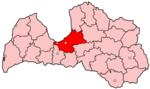
Battle of Riga was a battle during the Latvian War of Independence that started on May 22, 1919, when the German commander Rüdiger von der Goltz with his troops tried to occupy Riga against Soviet Latvia.

Excerpt from the Wikipedia article Battle of Riga (1919) (License: CC BY-SA 3.0, Authors, Images).

Battle of Riga (1919)
Tirgoņu iela, Riga Old Riga (Latgales apkaime)

Geographical coordinates (GPS) Address Nearby Places
placeShow on map

Wikipedia: Battle of Riga (1919)Continue reading on Wikipedia

Geographical coordinates (GPS)

Latitude Longitude
N 56.948888888889 ° E 24.106388888889 °
placeShow on map

Address

Tirgoņu iela 9
LV-1050 Riga, Old Riga (Latgales apkaime)
Latvia
mapOpen on Google Maps

Baltische Landswehrra Riga erasotzen, 1919ko maiatzak 22
Share experience

Nearby Places

Riga
Riga

Riga (; Latvian: Rīga [ˈriːɡa] (listen), Livonian: Rīgõ) is the capital and largest city of Latvia and is largest city in the Baltic states,and is home to 605,802 inhabitants which is a third of Latvia's population. The population of Rigas functional urban area, which stretches beyond the city limits, is estimated at 920,643 (as of 2023). The city lies on the Gulf of Riga at the mouth of the Daugava river where it meets the Baltic Sea. Riga's territory covers 307.17 km2 (118.60 sq mi) and lies 1–10 m (3.3–32.8 ft) above sea level, on a flat and sandy plain.Riga was founded in 1201 and is a former Hanseatic League member. Riga's historical centre is a UNESCO World Heritage Site, noted for its Art Nouveau/Jugendstil architecture and 19th century wooden architecture. Riga was the European Capital of Culture in 2014, along with Umeå in Sweden. Riga hosted the 2006 NATO Summit, the Eurovision Song Contest 2003, the 2006 IIHF Men's World Ice Hockey Championships, 2013 World Women's Curling Championship and the 2021 IIHF World Championship. It is home to the European Union's office of European Regulators for Electronic Communications (BEREC). In 2017, it was named the European Region of Gastronomy. In 2019, Riga received over 1.4 million foreign visitors. The city is served by Riga International Airport, the largest and busiest airport in the Baltic states. Riga is a member of Eurocities, the Union of the Baltic Cities (UBC) and Union of Capitals of the European Union (UCEU).

Eurovision Song Contest 2003

The Eurovision Song Contest 2003 was the 48th edition of the Eurovision Song Contest. It took place in Riga, Latvia, following the country's victory at the 2002 contest with the song "I Wanna" by Marie N. Organised by the European Broadcasting Union (EBU) and host broadcaster Latvijas Televīzija (LTV), the contest was held at the Skonto Hall on 24 May 2003. The contest was presented by last year's winner Marie N and former contestant Renārs Kaupers.Twenty-six countries participated in the contest, beating the record of twenty-five first set in 1993. It saw the return of Iceland, Ireland, the Netherlands, Norway and Poland after having been relegated from competing the previous year. Portugal also returned to the contest after being absent the previous year, while Ukraine participated in the contest for the first time. Denmark, Finland, Lithuania, Macedonia and Switzerland were relegated due to their poor results in 2002. The winner was Turkey with the song "Everyway That I Can", performed by Sertab Erener who wrote it with Demir Demirkan. This was Turkey's first victory in the contest after 28 years of participation. Belgium, Russia, Norway and Sweden rounded out the top five. Further down the table, the United Kingdom achieved their worst result to date, finishing twenty-sixth (last place) with no points. However, they avoided relegation due to being one of the "Big Four" countries at the time. The host country Latvia placed twenty-fourth (third from last) – this was the first time since 1995 that the host entry did not place in the top 10, and it was, overall, the worst result for a host entry since 1992. This was the last contest to take place on one evening. The EBU revealed that it would be adding a semi-final show to the competition in order to accommodate the growing number of interested countries wishing to take part in the contest. This was also the last contest in which a relegation system was used to determine which countries would participate in the following year's contest. As the Belgian entry was sung in an imaginary language, this was also the first time the contest featured a song with no parts performed in English or a language native to the country.

Siege of Riga (1656)

Siege of Riga by the Russian Army under Tsar Alexei Mikhailovich was the main event of the Russo-Swedish War. The fortifications of Riga consisted of a wall with ditch and 5 bastions around the old town. In 1652 Swedes had started construction of a new wall with 12 bastions around suburbs, but by 1656 the work had not been completed. The Russian vanguard consisting of the Vladimir v. Vizin reiters, Daniel Krafert infantry and Iunkmann dragoons approached Riga on August 20 and threw back the Swedes under count of Pärnu, Heinrich von Thurn into the city. Von Thurn was either killed, or captured in the action. The Swedes evacuated the suburbs and withdrew to the old town. A few days later, the main army under Tsar Alexei Mikhailovich arrived on the ships on the Duna River, and laid siege to Riga. The Russian army occupied three camps, two on the east bank of the Duna in Riga's suburbs, and a Corps under Ordyn-Nashokin on the west bank of the Duna, opposite the Kobrun entrenchment. As Russia had no full-fledged navy to intercept reinforcements coming to the Swedish garrison across the Baltic, Riga managed to hold out until October, when foreign officers commanding a small Russian flotilla defected to the other side and the Russians had to lift the siege. In the aftermath of this reverse, the Swedes recaptured much of Ingria, took the Pskov Monastery of the Caves and inflicted a heavy defeat on the Russian general Matvey Sheremetev in battle of Walk in 1657. The events of the siege were recorded in an engraving by Adam Perelli that was first published in 1697 in Samuel Puffendorf's work, Konung Carl X Gustafs Bragder.