place

Muzeon Park of Arts

Culture in MoscowLang and lang-xx code promoted to ISO 639-1Monument cemeteriesParks and gardens in MoscowSculpture gardens, trails and parks in Russia
Wikipedia external links cleanup from May 2022Wikipedia spam cleanup from May 2022
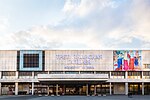
Sculpture park near an art museum in Moscow (45511425)

The Muzeon Park of Arts (formerly the Park of the Fallen Heroes or Fallen Monument Park) is a park outside the Krymsky Val building in Moscow shared by the modern-art division of the Tretyakov Gallery and the Central House of Artists. It is located between the Park Kultury and the Oktyabrskaya underground stations. The largest open-air sculpture museum in Russia, it has more than 700 artworks currently on display and another 200 in storage. The origins of the English-language exonym "Fallen Monument park" are unknown; Russian-language speakers either simply call the park the Sculpture Park of the Central House of Artists (Russian: Парк скульптуры ЦДХ) or reference its legal title, Muzeon Park of Arts (Russian: Парк Искусствcode: rus promoted to code: ru , Park Iskusstvcode: rus promoted to code: ru - literally: "Park of the Arts").

Excerpt from the Wikipedia article Muzeon Park of Arts (License: CC BY-SA 3.0, Authors, Images).

Muzeon Park of Arts
Krymskiy Val St, Moscow Yakimanka District

Geographical coordinates (GPS) Address Nearby Places
placeShow on map

Wikipedia: Muzeon Park of ArtsContinue reading on Wikipedia

Geographical coordinates (GPS)

Latitude Longitude
N 55.732777777778 ° E 37.605277777778 °
placeShow on map

Address

Баскин Роббинс

Krymskiy Val St
119049 Moscow, Yakimanka District
Moscow, Russia
mapOpen on Google Maps

Sculpture park near an art museum in Moscow (45511425)
Share experience

Nearby Places

Oktyabrskaya (Koltsevaya line)

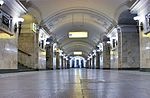
Oktyabrskaya (Russian: Октя́брьская) is a station on the Koltsevaya line of the Moscow Metro. Opened on 1 January 1950, Oktyabrskaya was part of the first segment of the fourth stage. Designed by Leonid Polyakov who took the mid-19th century Neoclassical triumphal Empire style as the basis, and incorporated the themes of the 1812 Victory over Napoleon to match the 1945 Soviet victory in the second world war, applying to the standard pylon tri-vault design. Both the central and platform vaults are divided by arches which have large bas-reliefs which contain medallions of Soviet Army soldiers surrounded by ornaments. The pylons contain a bas-relief centred ventilation grilles which are flanked by two anodized aluminum torches that give the overall golden glow to the bright grey marble that faces them. The station walls are ceramic tiles and are decorated with relief images of gilded wreaths and stars. The end of a central hall contains a miniature triumphal arch with a metallic gate that walls of a blue lit room, symbolising the time of peaceful life. The floor of the station is laid with grey and red granite, and the perimeter of the central hall is also bordered out by a pattern of bright and dark marble. The station has a large vestibule on the Kaluzhskaya square on the Garden Ring (named after the city of Kaluga) and hence the station's original name Kaluzhskaya (Калужская), renamed on 6 June 1961 to its present name (though the square's historic name was reverted in 1992). The vestibule on exterior contains large bas-reliefs of trumpeters that are lit by lamps concealed as columns underneath. Inside the ticket and escalator halls are decorated with casts and bas-reliefs containing battle banners, weapons figures of the Soviet Army and women symbolizing glory (work by G.Motovilov). In 1989 the stand-alone structure was built into the Moscow Institute of Steel and Alloys.In 1962, a set of staircases were added to the central hall for a transfer to the newly opened Oktyabrskaya of the Kaluzhskaya line.