place

Nikitsky Boulevard

Boulevards in MoscowCultural heritage monuments of regional significance in MoscowMoscow geography stubs
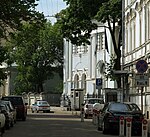
Nikitsky Blvd 14,12,10 01

Nikitsky Boulevard, Russian: Никитский бульвар, is a boulevard in central Moscow, Russia. The boulevard is a part of the Boulevard Ring, connecting Arbat Square with Nikitskie Vorota square at the crossing with the Nikitsky Street. The actual green boulevard extends for only two thirds of the street; its southern part was razed in the 1960s to make way for a tunnel under the Arbat Square. In 1950 the street was renamed Suvorovskiy Boulevard, Russian: Суворовский Бульвар in honour of generalissimus Alexander Suvorov. The old street name was reinstated in 1994. The street is home to a monument of writer Nikolai Gogol, placed deep in the courtyard of an 18th-century Talyzin mansion where the author spent his last few years 1848-1852 and where he burned the manuscript of the second volume of the Dead Souls in a fit 'sent by the devil.' This monument by sculptor Nikolay Andreyev depicted Gogol in a state of depression and originally (from 1909) stood on the northern tip of Gogolevsky Boulevard but, apparently due to Stalin's dislike of this depiction, was relocated in 1951 to its current place. A second monument to Gogol by sculptor Nikolai Tomsky (a much more socialist-realist effort, which shows no signs of Gogol's mental state) replaced the old one at the old site in 1956.

Excerpt from the Wikipedia article Nikitsky Boulevard (License: CC BY-SA 3.0, Authors, Images).

Nikitsky Boulevard
Nikitskiy Blvd, Moscow Presnensky District

Geographical coordinates (GPS) Address Nearby Places
placeShow on map

Wikipedia: Nikitsky BoulevardContinue reading on Wikipedia

Geographical coordinates (GPS)

Latitude Longitude
N 55.756111111111 ° E 37.599166666667 °
placeShow on map

Address

Арбатские Ворота

Nikitskiy Blvd
119019 Moscow, Presnensky District
Moscow, Russia
mapOpen on Google Maps

Nikitsky Blvd 14,12,10 01
Share experience

Nearby Places

Greater Church of the Ascension

The Greater Church of Christ's Ascension (Большое Вознесение) is one of the largest parish churches in downtown Moscow. It is a major landmark of Bolshaya Nikitskaya Street and Nikitskiye Vorota Square. It is named "greater" to prevent confusion with a nearby church of the same name. The church was commissioned by Prince Potemkin, the owner of a neighbouring messuage, shortly before his death. The yellow-colored Neoclassical building was erected between 1798 and 1816. The name of the architect is not known for certain. It has been attributed either to Matvey Kazakov, who built numerous Moscow churches in the reign of Catherine the Great, or Ivan Starov, who frequently worked for Potemkin. The edifice was overhauled to Osip Bove's designs after the 1812 Fire of Moscow. It stood unfinished for several decades and was not completed (under Afanasy Grigoriev's supervision) until 1848. The church holds historical significance for several reasons. It was in this church that Alexander Pushkin married Natalia Goncharova, a fact commemorated by their fountain statues on Nikitskie Vorota Square. It was also there that Patriarch Tikhon of Moscow held his last service; this is commemorated by a side-chapel dedicated in his name. The church was closed during the Soviet period, between 1931 and 1990. A 17th-century tent-like belfry, the sole remnant of an earlier church on the site, was demolished in 1937 and replaced by a statue of Aleksey Tolstoy, the "Red Count". The current belfry, freely based on Kazakov's designs and similar in style to the main church building, is of recent construction. There is a chapel of ease on Arbat Square.