place

Holy Cross Church, Tampere

20th-century Roman Catholic church buildings in FinlandAmuri, TampereBuildings and structures in TampereEuropean church stubsFinnish religious building and structure stubs
Roman Catholic churches completed in 1957
Catholic Church Tampere Finland

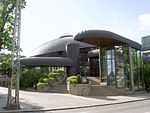
The Holy Cross Church (Finnish: Pyhän ristin kirkko, Swedish: Heliga korsets kyrka) is the name given to a religious building affiliated with the Catholic Church and is located in the city of Tampere, Finland. It offers religious services as the Mass in different languages (Finnish, Polish and English) in order to meet the different nationalities that make up the congregation. The Catholic parish of Tampere was formally established on September 3, 1957. Masses were held for the first time in Hotel Tammer, later in Emmaus. The congregation got its own church on November 22, 1969, being dedicated to the Holy Cross, and blessed with a parish hall, a presbytery, and other venues.

Excerpt from the Wikipedia article Holy Cross Church, Tampere (License: CC BY-SA 3.0, Authors, Images).

Holy Cross Church, Tampere
Amurinkuja, Tampere Amuri B (Keskustan suuralue)

Geographical coordinates (GPS) Address Phone number Website Nearby Places
placeShow on map

Wikipedia: Holy Cross Church, TampereContinue reading on Wikipedia

Geographical coordinates (GPS)

Latitude Longitude
N 61.49882 ° E 23.745297 °
placeShow on map

Address

Pyhän Ristin kirkko

Amurinkuja 21A
33230 Tampere, Amuri B (Keskustan suuralue)
Finland
mapOpen on Google Maps

Phone number
Pyhän Ristin seurakunta

call+35832127280

Website
risti.katolinen.fi

linkVisit website

Catholic Church Tampere Finland
Share experience

Nearby Places

Pyynikinrinne
Pyynikinrinne

Pyynikinrinne is a district of Tampere, Finland. It is located west of the city center. Pyynikinrinne is bordered on the south by the Pyynikki Esker nature reserve, on the north by Pirkankatu and on the east by Mariankatu. The western boundary of the district is the former border between Tampere and Pohjois-Pirkkala municipalities. The neighboring parts of the city are Pyynikki, Ylä-Pispala, Amuri, partly Särkänniemi and Kaakinmaa. Pirkankatu, which has long been a highway from the center of Tampere to the western parts of the city, was called the Pirkkala Highway until 1956. The Tipotie road, which once led across the Tampere–Pori railway line to the shores of Lake Näsijärvi, diverges from Pirkankatu at the former Tampere City Transport's department garage, also known as Rollikkahalli.A competition was held for the design of the Pyynikinrinne area, which was won in 1903 by architect Lars Sonck. The town plan drawn up by Sonck was confirmed in 1907. The town plan was in line with Art Nouveau ideals: blocks of varying sizes and shapes, streets following terrain and end views of the streets. The building stock of Pyynikinrinne is mainly protected. A particularly interesting object from an architectural point of view is the complex of villas bordering Palomäentie.The oldest surviving building stock on Pyynikinrinne is represented by, among others, Marjatta Hospital (Lambert Pettersson, 1912), the Technical School (R. Björnberg, 1912), the Durchman House (Oiva Kallio, 1915) and the Olán House (Wivi Lönn, 1916). Most of the district was built in the 1920s. The typical Pyynikinrinne Building Type is a two-storey wooden apartment building representing the classicism of the 1920s. The arm of Pyynikintori was built at the turn of the 1920s and 1930s from taller stone houses, designed by Martti Välikangas, Yrjö Lindegren, Jaakko Tähtinen and Veikko Kallio, among others. Architect Bertel Strömmer has had a special influence on the nature of Pyynikinrinne. Strömmer designed a large part of the Pyynikinrinne buildings and partially modified Sonck's town plan. Palomäentie 13 was Strömmer's first plan in his own name. Strömmer lived and kept his office at Palomäentie 22, a building that has since been demolished. Strömmer's surviving works in the Pyynikinrinne district include Pyynikki Sports Field with its auditorium (1922), Kisakentänkatu 10–14 (1924–25), Pyynikki Parish House (1928) and the vocational school (1939). After graduation, the vocational school was the largest public building in Tampere. Other significant buildings in the area include Pyynikinlinna (Jarl Eklund, 1923), Haapanen Villa (Veikko Kallio, 1929), Tampere Lyceum High School (Hjalmar Åberg and A. Willberg, 1935), Bishop's Residence (Gunnar Wahlroos, 1936) and Tampere Conservatoire. A special feature is Kilometritalo (Heikki Tiitola, 1923); this two-story residential building is 138 meters long. Pyynikintori, formerly known as Aleksanterintori or, familiarly, Plassi, once served as a marketplace and a center for horse trade. Domestic animals, including goats, cows, sheep and piglets, were sold at the Heinätori square, which is connected to Pyynikintori. In memory of the market square there is so-called Vaakahuone building (Lambert Petterson, 1913) between Heinätori and Pyynikintori. Today, Pyynikintori mainly operates as a bus terminal and parking area. The first bus station building in Finland, the western long-distance bus station (Bertel Strömmer, 1929), was built on Pyynikintori. An almost similar building was built for Tampere's eastern long-distance bus station, which was located in the Sori Square near the current bus station. The original station buildings functioned as service stations after the completion of the current Tampere Bus Station (1938) and have since been demolished. The Pyynikki sports field serves as a starting point and goal for women marathon event called Likkojen Lenkki, among other things. The Pyynikki Hall is a national and international venue for several indoor sports, such as volleyball and basketball. In addition, there is a small sports field along Palomäentie called Pikkusantamonttu. On the Pyynikinrinne, the Tampere Vocational College Tredu operates in three locations: Pyynikintie, Pirkankatu and Santalahdentie. Areas of study emphasize craftsmanship, such as the fashion industry, the barber-hairdresser line, and the electrical and construction engineering industry.

Särkänniemi (district)

Särkänniemi is a district of the city centre of Tampere, Finland, located on the shores of Lake Näsijärvi, north of the districts of Amuri and Finlayson. The most famous sights of the district are Näsinneula and Särkänniemi Amusement Park, but in addition to that, the district also houses the Haarla's old paper mill building. The Amuri railway stop has also ceased operations in Särkänniemi. The Särkänniemi district also includes the Siilinkari islet in Lake Näsijärvi. Särkänniemi is bordered on the south by Paasikivenkatu (formerly Paasikiventie), on the other side of which is the Amuri district, and on the west by the Santalahti district. The district includes the Onkiniemi residential area. The Särkänniemi district is joined by Santalahti on its west side, which is named after the bay of the same name in Lake Näsijärvi. The first industrial plant in the area was the Eliander match factory, founded in 1852; Sahanterä Oy (1889), Näsijärven Pahvitehdas (1909) and Haarla Paper Mill (1920) were born later. On the west side of Särkänniemi, Onkiniemi was a popular beach as early as the 19th century. The first sub-town plan of Särkänniemi was approved in 1915 and the town plan of the whole area in 1921 and the town plan of Santalahti in 1945. Some of the streets in the area have been named according to the factory's owner families; The founder of the Haarla paper mill, Rafael Haarla, a trade counselor, according to whom Haarlankatu has been named, donated the statues of Hämeensilta to the city of Tampere in 1929.A hotel and spa with restaurants and water experiences are planned around the amusement park, as well as new apartments. It will also be possible to travel to the area by tram in the future as part of the Tampere light rail network.

Näsinneula
Näsinneula

Näsinneula (Finnish: [ˈnæsiˌnːeu̯lɑ]; lit. 'the Needle of Näsi') is an observation tower in Tampere, Finland, overseeing Lake Näsijärvi. It was built in 1970–1971 and was designed by Pekka Ilveskoski. It is the tallest free-standing structure in Finland and at present the tallest observation tower in the Nordic countries at a height of 168 metres (551 ft). The tower opened in 1971 and is located in the Särkänniemi amusement park. There is a revolving restaurant in the tower 124 metres (407 ft) above the ground; one revolution takes 45 minutes. The design of Näsinneula was inspired by the Space Needle in Seattle. The idea of a revolving restaurant was taken from the Puijo Tower, which is located in Kuopio, the city of North Savonia. The base of the tower is at about 15 metres (49 ft) of elevation from lake Näsijärvi. There are two elevators, which were changed to new Kone elevators in 2020. Before the update the elevators were manufactured by Valmet-Schliren. The elevators go up to a height of 120 metres (390 ft), to the Pilvilinna ("Cloud Castle") café. The restaurant (called Näsinneula) is one story higher. The elevator ride to the top takes 27 seconds with a maximum speed of 6 m/s (20 ft/s) and the elevators carry a maximum of 16 people. The elevators are still the fastest public elevators in Finland. In the event of a blackout, the tower's own diesel emergency generator will start. In an emergency, people can be evacuated with stairs that have 700 steps. Beacon lights at the top of the tower display a weather forecast:

Särkänniemi
Särkänniemi

Särkänniemi (Finnish pronunciation: [ˈsærkæˌnːie̯mi]; translates to "Cape of Sandbank") is an amusement park in Tampere, Finland, located in the district by the same name. The park features an aquarium, a planetarium, Doghill Fairytale Farm, an art museum and an observation tower Näsinneula (Näsi Needle). Särkänniemi is the second most popular amusement park in Finland with Linnanmäki in Helsinki being the most popular one. Särkänniemi has five rollercoasters: the inverted coaster Tornado, the flying coaster Trombi, the family motorcycle launch coaster MotoGee and Hype, a launched steel Sky Rocket II coaster, and family coaster Vauhtimato ("Speedy Worm"). The half-pipe coaster called Half Pipe was recently removed due to multiple reasons. Särkänniemi is owned by the city of Tampere and attracts over 600 000 visitors annually. Särkänniemi is the biggest rival for Linnanmäki as the lead amusement park in Finland. Both are about the same size. The park gave up the dolphinarium in 2016 and the dolphins were safely transported to Attica Zoological Park in Greece. The park has more than 30 rides and attractions. There are also two water rides in the park, a log flume called Tukkijoki and a river rapids called Koskiseikkailu. In the future, a hotel and spa with restaurants and water experiences are planned around the amusement park, as well as new apartments. It is also possible to travel to the area by tram as part of the Tampere light rail network.

Kaakinmaa
Kaakinmaa

Kaakinmaa is a district in Tampere, Finland, located in the city center. It includes the area south of Pyynikki Church Park (Pyynikin kirkkopuisto) between the Hämeenpuisto park and the Mariankatu street. To the south, the area extends to Eteläpuisto on the shores of Lake Pyhäjärvi. The neighboring parts of the city are Nalkala in the east, Amuri in the north and Pyynikki and Pyynikinrinne in the west. Sometimes Kaakinmaa is incorrectly considered to belong to Pyynikki and Pyynikinrinne; however, Kaakinmaa has its own district. The most important street running through the area is Satamakatu, which rises west of the slope of Pyynikinharju from Laukontori, which together with Mariankatu and Hämeenpuisto form a busy traffic route from Pyynikintori to Ratina. Along the Koulukatu street there is the Koulukatu Field, where the hockey field and ice rink are frozen in winter. In Kaakinmaa, the Tampere Workers' Hall and the Tampere Workers' Theatre are located, as well as the old Pyynikki Brewery and the Klingendahl factory property. Next door to Klingendahl is the former Tampere Epidemic Hospital, built in 1910, which was used as a student dormitory until the summer of 2009 after the hospital closed. Almost all of the residential buildings in the area are apartment buildings, built mainly in the 1960s and 1970s to replace the earlier wooden houses built in the late 19th century. The primary schools operating in Kaakinmaa are the Alexander School of the 1st–6th grades and the Pyynikki School of the 7th–9th grades (former Tampere High School for Girls). At the corner of Satamakatu and Koulukatu is the Swedish-language school (Svenska samskolan i Tammerfors), which includes grades 1-9 of the comprehensive school and the upper secondary school. A brewery has previously operated in Kaakinmaa. In 1897, a brewery was established on the corner of Tiilitehtaankatu and Papinkatu, which later became Oy Pyynikki. In 1903, another brewery operating in Tampere, Oy Iso Oluttehdas, and Oy Pyynikki merged to form Näsijärven Osake-Oluttehdas, which in 1920 took the name Oy Pyynikki Ab. Until 1992, Pyynikin Brewery produced the Amiraali beer brand, which is popular with the local population and is still available in Japan with a label with the image of Admiral Tōgō Heihachirō (1848–1934) from the Tupgō flagship Mikasa's museum store in Yokosuka. The brewing business in Tampere was discontinued soon after Pyynikki Oy came under Sinebrychoff. The same fate in the hands of Sinebrychoff was later experienced by the Pori Brewery. In 2012, the Pyynikki craft brewery was established in Tampere to continue the tradition of the Pyynikki brewery, although for the time being, due to the lack of suitable premises, it operates in Rahola. The name of Kaakinmaa derives from the kaakinpuu tree, also known as pillory, used to punish evildoers on the site of Tampere's co-educational high school until the second half of the 19th century. After the settlement of Kaakinmaa, the kaakinpuu tree was transferred to a sand pit along the current Pirkankatu, where it was located until the new penalty law abolished cropping in 1894. The town plan for Kaakinmaa was completed in 1868. In 1870, the area of Kaakinmaa was still uninhabited, but twenty years later there were already about a thousand inhabitants. At the beginning of the 20th century, the inhabitants of Kaakinmaa were mainly engaged in various professions.On the western side of Kaakinmaa, along Mariankatu, in 1936–1973, there was a Christmas Sign Home owned by the Finnish Tuberculosis Resistance Association (Filha ry), which cared for the newborn children of mothers with tuberculosis. After the operation of the nursing home ended, the building was demolished and there is now an apartment building on its site.