place

Ministry of Natural Resources and Environment (Russia)

Economy of RussiaEnvironment ministriesEnvironment of RussiaFederal ministries of RussiaForestry in Russia
Forestry ministriesNatural resources ministriesOrganizations based in Moscow
Министерство природных ресурсов и экологии Российской Федерации (Минприроды России)

The Ministry of Natural Resources and Environment of the Russian Federation (Russian: Министерство природных ресурсов и экологии Российской Федерации) is a ministry of the Government of Russia responsible for managing natural resources and the environment.Alexander Kozlov has served as Minister of Natural Resources and Environment since 10 November 2020.

Excerpt from the Wikipedia article Ministry of Natural Resources and Environment (Russia) (License: CC BY-SA 3.0, Authors, Images).

Ministry of Natural Resources and Environment (Russia)
Большая Грузинская улица, Moscow Presnensky District

Geographical coordinates (GPS) Address Nearby Places
placeShow on map

Wikipedia: Ministry of Natural Resources and Environment (Russia)Continue reading on Wikipedia

Geographical coordinates (GPS)

Latitude Longitude
N 55.7625 ° E 37.580277777778 °
placeShow on map

Address

Большая Грузинская улица 4/6 с4
123242 Moscow, Presnensky District
Moscow, Russia
mapOpen on Google Maps

Министерство природных ресурсов и экологии Российской Федерации (Минприроды России)
Share experience

Nearby Places

Barrikadnaya
Barrikadnaya

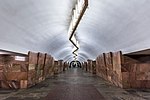
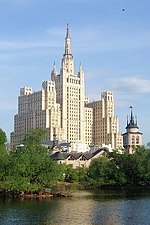
Barrikadnaya (Russian: Баррикадная) is a station on the Tagansko-Krasnopresnenskaya Line of the Moscow Metro. It is named after the events of the Revolution of 1905, when it was a site for barricades on Krasnaya Presnya street. The station was opened in 1972 as the first station on the Krasnopresenenskiy line, and for three years was its southern terminus, until the tunnel to Pushkinskaya connected it to the Zhdanovskiy line. The station was built following a typical pylon design, but due to unfavourable underlying geological conditions the pylons eventually had to be widened. The station architects Strelkov and Polikarpova used pink and red marble in the pylons. The walls use with different shades of pink, red, blue and grey marble. The central hall had to be extended as the station was initially designed for extended seven-carriage trains (although the line has been using eight-carriages since the late 1980s). The entrances to the central hall are all decorated with metallic artworks. The entrance to the station is located on Barrikadnaya Street, which links Krasnaya Presnya with the Garden Ring, and is externally decorated with stone artwork depicting the events of 1905. Across the road is one of Stalin's Seven Sisters skyscrapers. From the opposite end of the central hall there is a transfer to the Krasnopresnenskaya station of the Koltsevaya Line The daily passenger traffic of the station amounts to 32,400 people via the station entrance, and 118,500 using the transfer.

Moscow Zoo
Moscow Zoo

The Moscow Zoo or Moskovsky Zoopark (Russian: Московский зоопарк) is a 21.5-hectare (53-acre) zoo founded in 1864 by professor-biologists, K.F. Rulje, S.A. Usov and A.P. Bogdanov, from the Moscow State University. In 1919, the zoo was nationalized. In 1922, the ownership was transferred to the Government of Moscow and has remained under Moscow's control ever since.The zoo had an area of 10 hectares (25 acres) when it first opened, with 286 animals. In 1926, the zoo was expanded to adjacent lands, increasing the area to 18 hectares (44 acres). The zoo's original buildings were wooden, built in the old Russian style with intricate wood trims. In 1990, the zoo was renovated. Notable additions include a new main entrance in the shape of a large rock castle, and a footbridge that connected the old (1864) and new (1926) properties of the zoo. Prior to construction of the footbridge, the zoo operated as two 'separate zoos' because the Bolshaya Gruzinskaya Street divides the properties. In addition, the zoo was expanded once more. New exhibits were opened including a sea aquarium, an aviary, a creatures of the night exhibit, a sea lion exhibit and a section aimed at children. Waterfalls and streams were added throughout to give the zoo a more natural feeling. The Moscow zoo has over 7,500 animals representing about 1,000 species and covers an area of about 21.5 hectares (53 acres). The zoo studies animal's behavior, feeding and reproduction, and breeds rare endangered species.