place

Action of 22 August 1866

1866 in ChileAugust 1866 eventsBattles of the Chincha Islands WarConflicts in 1866Naval battles involving Chile
Naval battles involving Spain
10corbetatornado
10corbetatornado

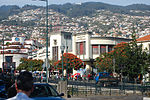
The action of 22 August 1866 occurred during the Chincha Islands War near Funchal, on the island of Madeira, and was the final action of the war battle between Spanish and Chilean forces. The Chilean steamer Tornado was captured by the Spanish frigate Gerona, on 22 August 1866 off the island of Madeira. Tornado had arrived in Madeira under the command of Juan MacPherson, an English commander in service of the Chilean Navy. The Chilean ship had sailed to Madeira on 21 August to make provisions of charcoal and food supplements and to recruit sailors for its crew. Although the intent was to remain until 23 August, at 14:00 hours on 22 August the watch aboard ship alerted the captain to the presence of an armed vessel, the Spanish frigate Gerona. Captain McPherson decided to leave all his supplies on the dock and got the ship underway 90 minutes after the first sighting of Gerona. In its haste, Tornado had not been inspected by or granted permission to leave port from the Portuguese authorities in Madeira. Two blank charges were fired to signal that Tornado should stop, but Tornado continued out of port. Gerona had been sent from Cádiz under the command of captain Benito Ruiz de la Escalera specifically to capture Tornado and its sister ship, Cyclone. The firing of the charges alerted Gerona of the presence of Tornado and Gerona gave chase. At 22:30 Gerona fired a blank shot. Tornado continued to ignore the intent. Gerona followed up with three live shots; Tornado stopped its engines and struck its colors. The crew of Tornado was transferred to Gerona. Tornado was manned by a prize crew commanded by naval lieutenant Manuel de Bustillo y Pery. Tornado sailed for Cádiz, where it arrived on 26 August, while Gerona returned to Madeira in a fruitless search for Tornado's sister ship Cyclone.

Excerpt from the Wikipedia article Action of 22 August 1866 (License: CC BY-SA 3.0, Authors, Images).

Action of 22 August 1866
Funchal Sé

Geographical coordinates (GPS) Address Nearby Places
placeShow on map

Wikipedia: Action of 22 August 1866Continue reading on Wikipedia

Geographical coordinates (GPS)

Latitude Longitude
N 32.633333333333 ° E -16.9 °
placeShow on map

Address

Praça da Autonomia


9000-628 Funchal, Sé
Portugal
mapOpen on Google Maps

10corbetatornado
10corbetatornado
Share experience

Nearby Places

Roman Catholic Diocese of Funchal

The Diocese of Funchal (Latin: Dioecesis Funchalensis) is a Latin Church ecclesiastical territory or patriarchal archdiocese of the Catholic Church in Portugal. It was originally created on 12 June 1514 by the papal bull Pro excellenti præeminentia from Pope Leo X, following the elevation of Funchal from a village to the status of city, by King Manuel I of Portugal (Royal Decree of 21 August 1508). The diocese was a suffragan of the Archdiocese of Lisbon. Before the issuance of the papal bull, between 1433 and 1514 the civil and religious administrations were in charge of the Grand-Master of the Order of Christ. In fact all Portuguese Atlantic territories were under the jurisdiction of Order of Christ, until the situation changed in 1514 with the creation of the Diocese. Once the diocese was created, the bishop of Funchal had jurisdiction over the entire area occupied by the Portuguese in the Atlantic and Indian Oceans. Thus, the Diocese comprised not only the Islands of Madeira, but all the territories discovered or to be discovered by the Portuguese. Thus, its jurisdiction extended throughout the western and eastern African territory, Brazil and Asia. Given its jurisdiction extent, the diocese's first bishop, D. Diogo Pinheiro used the title of Primate.Nineteen years later, on 31 January 1533, the diocese was elevated to archiepiscopal rank. For twenty-two years it was, geographically, the largest metropolitan ecclesiastical province in the world, having as suffragan dioceses: Azores, Brazil, Africa and Goa. The first (and only) Archbishop was D. Martinho of Portugal, also held the title of Primate.Following the Portuguese Empire's economic and social progress new dioceses were created in 1534, whose areas were detached from the Diocese of Funchal: Goa, Angra, Santiago and São Tome, São Salvador da Bahia. Later, on January 31, 1533, the Diocese of Funchal was elevated to the category of metropolitan and primate. In 1551 Pope Julius III revoked the situation by passing Funchal to the simple suffrage bishopric of the Archdiocese of Lisbon, as it remains today.The first bishop to visit the diocese was D. Ambrósio Brandão, in 1538, on behalf of the diocesan bishop D. Martinho of Portugal. After the death of D. Martinho de Portugal, the only archbishop of Funchal, the cathedral remained vacant until 1551. One year later, in 1552, Fr. Gaspar do Casal, who did not reside on the island, was appointed, and the most salient fact of his action was his participation in the Council of Trent. His successors, D. Jorge de Lemos, D. Jerónimo Barreto and D. Luís Figueiredo de Lemos, applied the Council and were the true workers of this reform. The first bishop of Funchal to actually reside, full-time, after his appointment was D. Jorge de Lemos, in 1558.Throughout its more than five centuries of history the diocese has only be headed by two Madeirans so far: D. Aires de Ornelas e Vasconcelos, who would then become Archbishop of Goa, and D. Teodoro de Faria.Until the 20th century, the bishops of Funchal used the title of Bishop of Madeira, of Porto Santo, of Desertas and of Arguim. The seat of the Diocese of Funchal is the Cathedral of Our Lady of the Assumption. On 8 March 2007, Pope Benedict XVI appointed António Carrilho (António III) as Bishop of Funchal, until then Auxiliary Bishop of Porto. Together with Cardinal Fernando Filoni, António III, presided over the celebrations for the 500th anniversary of the foundation of the diocese on 17 May 2014.The current bishop of Funchal is Nuno I, who took office on February 17, 2019.