place

Skanste

Neighbourhoods in Riga
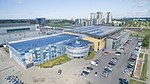
Skanstes masivi panoramio (1)

Skanste is a neighbourhood located in the center of Riga, the capital of Latvia, and is currently becoming the most modern part of Riga. Geographically, the neighborhood is situated in the northern part of the railway ring on the right bank of the Daugava, bordering the Sarkandaugava, Brasa, Centrs, and Pētersala-Andrejsala neighborhoods.Skanste is considered part of the compact center of Riga. The neighborhood's central traffic artery is Skanstes Street, but the area is delineated by Pulkveža Brieža, Hanzas, Vesetas, and Duntes streets, as well as Ganību dambis, and the railroad.The area that for decades was allotted for kitchen garden plots, has now been developed to include office towers, sports infrastructure complexes and residential buildings. Next to the historical heart of Riga and its so-called "quiet center", Skanste is developing as a contemporary neighborhood, attractive both to city residents and entrepreneurs and fosters Riga's competitiveness regionally and in the European context. Skanste continues to grow and there are several plans that will be implemented in the coming years. The Skanste neighborhood takes up 215 hectares (530 acres) measuring by perimeter, and its border is more than six kilometers (4 miles) long. Currently, more than 12,000 people live or work in Skanste, and if large-scale plans for the neighborhood are carried out, these numbers could exceed 42 thousand. On average, the Elektrum Olympic Center and Arena Riga receive 1.9 million visitors a year. When the Metta Youth Football Education Center, a multifunctional private clinic, the Riga Conference, the Concert Center and other projects come to fruition, the annual number of Skanste visitors will grow to 3 million people.

Excerpt from the Wikipedia article Skanste (License: CC BY-SA 3.0, Authors, Images).

Skanste
Skanstes iela, Riga Skanste

Geographical coordinates (GPS) Address Nearby Places
placeShow on map

Wikipedia: SkansteContinue reading on Wikipedia

Geographical coordinates (GPS)

Latitude Longitude
N 56.9703 ° E 24.1183 °
placeShow on map

Address

Skanstes iela 8
LV-1013 Riga, Skanste
Vidzeme, Latvia
mapOpen on Google Maps

Skanstes masivi panoramio (1)
Share experience

Nearby Places

Latgyprogorstroy

Institute "Latgyprogorstoy" (Russian: Институт "Латгипрогорстрой") - was a main institute of designing apartment houses in Latvian SSR. Full name of the institute was Latvian state institute of designing state construction (Russian: Латвийский государственный институт проектирования государственного строительства). Founded in 1951, the institute took part in construction of the most modern Riga, Liepāja and Daugavpils neighbourhoods. Not artistic, with a big number of defects, these houses served the main purpose - to give Latvia a big number of cheap living space. Most of the Latgyprogorstroy's projects were standard and had a number consisting of three figures. Houses built under the projects of the institute has a big safety factor and still are the main living fund of Latvian cities. Beside the projects of apartment houses the institute designed the projects of schools, kindergartens, water pipe and sewerage networks. Latgyprogorstroy also took part in the construction of the city Slavutych - the new living place for the victims of Chernobyl Nuclear Power Plant accident.The main office building of the Latgyprogorstoy was located in Riga at Gorky St. 38 (now Kr. Valdemara St.). The institute also had the branches in Liepāja and Daugavpils. The institute ceased its existence in 1990. On the base of the institute was founded public limited company Pilsētprojekts.

Corner House (Riga)
Corner House (Riga)

The Corner House (Latvian: Stūra māja) is a historic building in the city center of Riga, Latvia. It was known as the headquarters of the Soviet KGB in Latvia from 1940 to 1941 and from 1944 to 1991. The official address is 61 Brīvības iela (Brīvības Street). Designed by architect Aleksandrs Vanags, the construction of the house was started in 1910, and was built in 1912 as apartments and shops. It housed the music school of the Imperial Russian Society of Music, a library and a bookstore, sweets and fruit, dairy products, flower shops, and a pharmacy of the Ministry of National Welfare. During the Latvian War of Independence, the Latvian Revolutionary War Committee used the building briefly in 1919. In 1920, the new government of independent Latvia took over the building for government use, including the Ministry of the Interior and other offices. The Interior Affairs Ministry of Latvia used the building in the 1920s and 1930s. At different times the building was owned by the Public Affairs Ministry, State Statistical Bureau, and Forestry Department. It was home to the Latvian Anti-Alcohol Society, different publishing houses, as well as Education and Culture Directorate, Art and Public Affairs Department, Church and Confessions Department, as well as other institutions. In 1940, during the Soviet occupation of Latvia in 1940, the house was converted into KGB offices and dozens of cells. In 1941–1944, during most of the German occupation of Latvia during World War II, a youth group called “National Watch” occupied the building, as well as Latvia's puppet government, appointed by the Nazis. With the Soviet re-occupation of Latvia in 1944, the Soviet Red Army took over the house once again.After the restoration of Latvia's independence, State Police occupied this building from the beginning of 1990 until mid-July 2008. In 2014, the house was opened as part of Riga's tenure as a European Capital of Culture. From 2015 the house is used by the Museum of the Occupation of Latvia for an exposition about the history of the KGB in Latvia. In 2015, the house underwent a facade renovation. In 2020, the house was offered at auction by the government.