place

Tampere City Hall

Buildings and structures in TampereCity and town halls in FinlandFinnish building and structure stubs
Tampereen kaupungintalo

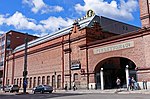
The Tampere City Hall (Finnish: Tampereen Raatihuone; Swedish: Tammerfors rådhus) is a Neo-Renaissance building in Tampere, Finland, situated at the edge of the Tampere Central Square. The current city hall was built in 1890 and was designed by Georg Schreck. The palacial building has many halls and the city of Tampere holds many events there. During the Great Strike in 1905, the so-called "Red Manifest" was read from the balcony of the Tampere City Hall.

Excerpt from the Wikipedia article Tampere City Hall (License: CC BY-SA 3.0, Authors, Images).

Tampere City Hall
Hämeenkatu, Tampere Tammerkoski (Keskustan suuralue)

Geographical coordinates (GPS) Address External links Nearby Places
placeShow on map

Wikipedia: Tampere City HallContinue reading on Wikipedia

Geographical coordinates (GPS)

Latitude Longitude
N 61.498 ° E 23.7593 °
placeShow on map

Address

Tampereen raatihuone

Hämeenkatu 16
33200 Tampere, Tammerkoski (Keskustan suuralue)
Finland
mapOpen on Google Maps

linkWikiData (Q4356287)
linkOpenStreetMap (93500771)

Tampereen kaupungintalo
Share experience

Nearby Places

Tampere
Tampere

Tampere ( TAM-pər-ay, US also TAM-pər-ə, TAHM-pər-ay, Finnish: [ˈtɑmpere] ; Swedish: Tammerfors, Finland Swedish: [tɑmærˈforsː] ) is a city in the Pirkanmaa region, located in the western part of Finland. Tampere is the most populous inland city in the Nordic countries. It has a population of 255,066; the urban area has a population of 341,696; and the metropolitan area, also known as the Tampere sub-region, has a population of 416,653 in an area of 4,970 km2 (1,920 sq mi). Tampere is the second largest urban area and the third most populous single municipality in Finland, after the cities of Helsinki and Espoo, and the most populous Finnish city outside the Helsinki Metropolitan Area. Today, Tampere is one of the most important urban, economic and cultural centres in the entire inland region.Tampere and its surroundings are part of the historic province of Satakunta. The area belonged to the province of Häme from 1831 to 1997; over time, it has often been considered a province of Tavastia. For example, in Uusi tietosanakirja, published in the 1960s, the Tampere sub-region is presented as part of the then province of Tavastia. Around the 1950s, Tampere and its surroundings began to establish themselves as a separate province of Pirkanmaa. Tampere became the centre of Pirkanmaa, and Tammermaa was also used several times in the early days of the province, for example in the Suomi-käsikirja published in 1968.Tampere is wedged between two lakes, Lake Näsijärvi and Lake Pyhäjärvi, with an 18 m (59 ft) difference in water level, and the rapids that connect them, Tammerkoski, have been an important source of power throughout history, most recently for generating electricity. Tampere is known as the "Manchester of the North" because of its past as a centre of Finnish industry, which has given rise to its Finnish nickname "Manse" and terms such as "Manserock". Tampere has also been officially declared the "Sauna Capital of the World" because it has the most public saunas in the world.Helsinki is about 160 km (100 mi) south of Tampere and can be reached by Pendolino high-speed train in 1 hour 31 minutes and by car in 2 hours. The distance to Turku is about the same. The Tampere–Pirkkala Airport is the eighth busiest airport in Finland, with more than 230,000 passengers using it in 2017. Tampere is also an important transit route for three Finnish highways: Highway 3 (E12), Highway 9 (E63) and Highway 12. The Tampere light rail had two lines when it started operating in 2021.Tampere is ranked 26th in the list of 446 hipster cities in the world and is often rated as the most popular city in Finland. The positive development of Tampere and the Tampere metropolitan area has continued into the 21st century, largely due to the fact that Tampere is one of the most attractive cities in Finland.

Laukontori
Laukontori

Laukontori (or the Laukko Square, also known as Alaranta) is a market square in the southern part of the city center of Tampere, Finland, on the shores of Lake Pyhäjärvi. It is located just a few hundred meters from Tampere Central Square. Square's beach serves as a harbor for cruise ships to the Viikinsaari island and the city of Hämeenlinna in the summer. Laukontori got its name from the first steamboat sailing on Lake Pyhäjärvi, the Laukko paddle steamer, which was built in 1859 but scrapped as early as 1864. As such, the ship was so significant that the people of Tampere began to use the name Laukontori, or the square on which Laukko landed. The same berth was later used by another steamboat named Laukko. Alaranta and Alasatama have been used as parallel names for Laukontori, although on the other hand the port of the Mustalahti bay on the shores of Lake Näsijärvi has never been called Yläranta or Yläsatama. Laukontori has officially belonged to the Tampere street system in 1868–1886 and again since 1897. In the intervening years, the market was called Kalatori ("fish market square"). Residential apartment buildings were built on the outskirts of Laukontori in the early 20th century, and the area was a favorite residential area for wealthy city dwellers. In 1905, almost half of the residents of the entire Nalkala district were considered to belong to the highest social group. Until the 1950s, Laukontori was a lively trading place where rural residents who came to Tampere from the Lake Pyhäjärvi area sold their products on inland waterway vessels. In addition to Tammelantori, Laukontori is also a famous "original" place to enjoy the mustamakkara black sausage. The Laukontori is led across the Tammerkoski by the Vuolteensilta bridge, completed in 1985, and the Laukonsilta bridge, completed in the summer of 2010, connects Laukontori and the Ratina district.