place

Revelation of Christ Church, Riga

Churches in RigaCommons category link is the pagename
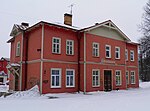
Transfiguration of Jesus Riga 0597

Revelation of Christ Church (Latvian: Kristus Apskaidrošanās Pareizticīgā Baznīca, Russian: Храм Преображения Господня, also referred to as Alexander Vysotskaya) is an Eastern Orthodox church in Riga. It is located near the Sarkandaugava railway station. Church was built in 1890 by architect Apoloniuss Aleksandrs Edelsons. The church is situated at the address 11 Meža Prospect.

Excerpt from the Wikipedia article Revelation of Christ Church, Riga (License: CC BY-SA 3.0, Authors, Images).

Revelation of Christ Church, Riga
Meža prospekts, Riga Mežaparks

Geographical coordinates (GPS) Address Nearby Places
placeShow on map

Wikipedia: Revelation of Christ Church, RigaContinue reading on Wikipedia

Geographical coordinates (GPS)

Latitude Longitude
N 56.996388888889 ° E 24.133055555556 °
placeShow on map

Address

Kunga Apskaidrošanās pareizticīgo baznīca

Meža prospekts 11
LV-1005 Riga, Mežaparks
Vidzeme, Latvia
mapOpen on Google Maps

Transfiguration of Jesus Riga 0597
Share experience

Nearby Places

Forest Cemetery, Riga

Forest Cemetery (Latvian: Rīgas Meža kapi) is an 85 hectares (210 acres) large cemetery in the northwestern part of Riga, the capital of Latvia, between the neighbourhoods of Mežaparks and Čiekurkalns. Formally, the cemetery is divided between 1st Forest Cemetery, with entrance from Aizsaules Street, and 2nd Forest Cemetery, with entrance from Gaujas Street. In 1904, German Lutheran congregations in Riga inquired the Riga City Council for allotment of land for a cemetery in the Mežaparks neighbourhood. It was planned to become a new large cemetery after the Great Cemetery, that was established 1773 in Riga and had exhausted its potential. The prominent Baltic-German landscape architect Georg Kuphaldt was author of the original construction project presented 1908, which should have appeared as a park with a central via funeralis, with many small and lateral paths along the graves with low fences and small monuments. The Forest Cemetery was established 29 July 1910 following a decision made by the 3rd Imperial Duma, and it was inaugurated 19 June 1913.All burial ceremonies were conducted in a building erected 1913 after blueprints by the Baltic-German architect Wilhelm Neumann.During World War I, when the front closed in on Riga in 1916, the Forest Cemetery was receiving many fallen Latvian Riflemen. After a lengthy debate with local congregations, the Imperial Duma sanctioned the construction of a military cemetery, on land transferred from the Forest Cemetery, a cemetery that later was named Brothers' Cemetery.The Forest Cemetery has many sculptural memorials and tombstones created by notable sculptors. Many notable Latvian politicians, military, and public figures are buried at the Forest Cemetery.