place

Bessastaðir

Icelandic building and structure stubsOfficial residences in IcelandPalace stubsPresidential residences
IS bessastadastofa
IS bessastadastofa

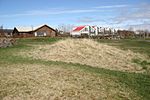
Bessastaðir (Icelandic pronunciation: ​[ˈpɛsːaˌstaːðɪr̥]) is the official residence of the president of Iceland. It is situated in Álftanes, about 15 kilometres (9.3 mi) from the capital city, Reykjavík.

Excerpt from the Wikipedia article Bessastaðir (License: CC BY-SA 3.0, Authors, Images).

Bessastaðir
Bessastaðavegur,

Geographical coordinates (GPS) Address Nearby Places
placeShow on map

Wikipedia: BessastaðirContinue reading on Wikipedia

Geographical coordinates (GPS)

Latitude Longitude
N 64.105833333333 ° E -21.995555555556 °
placeShow on map

Address

Bessastaðastofa

Bessastaðavegur
225
Iceland
mapOpen on Google Maps

IS bessastadastofa
IS bessastadastofa
Share experience

Nearby Places

Vesturbæjarlaug
Vesturbæjarlaug

Vesturbæjarlaug, also known as Sundlaug Vesturbæjar, is a swimming pool in the Vesturbær district in Reykjavík, the capital of Iceland. It has a 12.5×25 m main swimming pool with depth ranging from 0.9 to 3.9 m. There is also an adjacent playpool, several hot tubs, a cold tub, outdoor showers and a sauna. The pool was opened on November 25 1961. It had two "firsts" for Icelandic swimming pools: the large playpool for children, and the spiral-shaped hot tubs, with dimensions based on the pool of Snorri Sturluson in Reykholt. These design elements were reused on a larger scale by architect Einar Sveinsson for the much larger Laugardalslaug, which opened in 1968, and the design of the hot tubs was widely copied by other Icelandic swimming pools over the next years. The pool house was designed by architect Bárður Ísleifsson, but the hot tub and outdoor area was designed by Gísli Halldórsson. The pool reception area was initially decorated with wall paintings by British-Icelandic artist Barbara Árnason, who drew inspiration from the saga Harðar saga ok Hólmverja, where Helga Haraldsdóttir saved her two sons by swimming across Hvalfjörður. Most of these decorations were removed in 1995, but a small part remains on the ceiling. Vesturbæjarlaug was the first swimming pool in Iceland that was designed for leisure, and not just swimming. Since it opened it has been a popular hub for the neighborhood where people meet and chat.

Árni Magnússon Institute for Icelandic Studies

The Árni Magnússon Institute for Icelandic Studies (Icelandic: Stofnun Árna Magnússonar í íslenskum fræðum [ˈstɔpnʏn ˈau(r)tna ˈmaknusˌsɔːnar iː ˈistlɛnskʏm ˈfraiːðʏm]) is an institute of the Ministry of Education, Science and Culture of Iceland which conducts research in Icelandic and related academic studies, in particular the Icelandic language and Icelandic literature, to disseminate knowledge in those areas, and to protect and develop the collections that it possesses or those placed in its care. It is named after Árni Magnússon, a 17th–18th century collector of medieval Icelandic manuscripts. The Árni Magnússon Institute (Stofnun Árna Magnússonar) was an academic institute located in Reykjavík, Iceland. The institute had the task of preserving and studying mediaeval Icelandic manuscripts containing Landnáma, Heimskringla and the Icelandic sagas. On 1 September 2006, this institute was merged with the Icelandic Language Institute, the University of Iceland Institute of Lexicography, the Sigurður Nordal Institute, and the Place-Name Institute of Iceland to create the current Árni Magnússon Institute for Icelandic Studies. It is a university institution with its own board and financing. The Minister of Education, Science and Culture appoints a five-member board for four-year terms. Three members are appointed according to nomination by the University Senate and two without nomination, with one of those two acting as chairman. The minister appoints a director for five-year terms on the recommendation of the board. Dr. Vésteinn Ólason was appointed director of the Institute of Icelandic Studies on 12 September 2006. Vésteinn had been the director of the Árni Magnússon Institute from 1 May 1999 until 1 September 2006, after which it was merged with four other institutes to create the Árni Magnússon Institute for Icelandic Studies. Professor Guðrún Nordal took over as director of the institute on 1 March 2009, appointed for a period of five years.