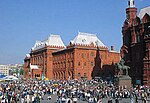
The Moscow Print Yard (Russian: Московский Печатный двор) was the first publishing house in Russia. It was established in Kitai-gorod at the behest of Ivan the Terrible in 1553. The historic headquarters of the Print Yard now house the Russian State University for the Humanities.
Moscow Print Yard was first mentioned in Aufzeichnungen über den Moskauer Staat by Heinrich von Staden. It is known to have published Lenten Triodion, Triodion in Pictures, Gospel, Psalter, and other books, which didn't have any imprints (hence, another bookish name of the Print Yard - Anonymous Printing House). On March 1 of 1564, Ivan Fyodorov and Pyotr Timofeyev (Mstislavets) published the very first dated book called Apostle (Апостол) at the Moscow Print Yard. In 1565, the printing house published Chasovnik (Часовник, or Book of hours) and then Psalter (1568).
In 1612, Moscow Print Yard was destroyed by fire, but soon it would be rebuilt. In 1620, they erected a two-story stone chamber for the Print Yard, moving seven typesetters and eighty employees from the Kremlin to the new premises. In 1625, they built several underground storage rooms and tunnels leading to the Kremlin. The fire of 1634 destroyed all of the buildings belonging to the Print Yard. In 1642–1643, they built several new stone chambers for the publishing house under the supervision of an apprentice from Stoneworks Prikaz named T.Shaturin. In 1644, an apprentice I.Neverov and a foreigner named Christopher erected Gothic stone gates with towers, which divided the chambers of the Print Yard in two. These buildings housed the Bookprinting Prikaz and Proofreading Chamber. In 1679, they dismantled the so-called old "Big Chamber" building in the Print Yard, which was adjacent to the wall of Kitai-gorod. Stonemasons S.Dmitriyev and I.Artemyev supervised the erection of a new building over the old foundation, which would later be painted by a court icon painter L.Ivanov and house the Proofreading Chamber and a library.
In 1653, Patriarch Nikon (who supervised the work of the Print Yard) sent a scientific expedition to the East. Its leader A.Sukhanov brought five hundred Greek manuscripts from Mount Athos to Moscow. These books laid the foundation for the library of the Moscow Print Yard. In 1681, they opened a Greek school on the premises of the printing house. By the end of the 17th century, the staff of the Print Yard had already numbered 165 people. It was placed under the authority of the Big Palace Prikaz (Приказ Большого дворца) and published the so-called menology books (Анфологион, or Anfologion, 1660), polemical works, translations, textbooks (Букварь, or Primer by Vasily Burtsov-Protopopov, 1634; Грамматика, or Grammar by Meletiy Smotritsky, 1648; Арифметика, or Arithmetics by Leonty Magnitsky, 1703 etc.). All in all, the Moscow Print Yard published 30 books (1000 copies each) between the late 16th – early 17th centuries. Proofreaders Andronik Timofeyev Nevezha and Ivan Andronikov Nevezha influenced the formation of a certain style of Moscow Cyrillic editions of the 17th century. Karion Istomin is known to have worked at the Print Yard first as a proofreader (since 1682) and then its inspector (1698-1701).
In 1703–1711, the Moscow Print Yard published the first Russian newspaper Vedomosti. In 1710, proofreader Fyodor Polikarpov-Orlov (future director of the publishing house in 1726-1731) presented a copy of the Alphabet (Азбука) with the pictures of ancient and contemporary Slavonic letters to Peter the Great. In 1564–1711, the Moscow Print Yard published approximately 700 kinds of books (some of them, such as the Alphabet, reached 10,000 copies in 1657-1677). In 1721, the Print Yard was transferred under the authority of Most Holy Synod, its publishing house being transformed into Synodal. In the middle of the 18th century, they constructed the baroque-style side housing together with the printing and library premises, which would close the perimeter of the yard (architects Ivan Fyodorovich Michurin and Dmitry Ukhtomsky). In late 18th – early 19th century, the Print Yard building on Nikolskaya Street were dismantled and replaced with a monumental edifice of the Synodal Publishing House (1811-1815, architect Ivan Mironovsky). In the 19th century, the buildings of the publishing house were perceived as a single architectural ensemble with the towers and walls of Kitai-gorod, with the add-ons and alterations by future generation architects (Mikhail Chichagov, Nikolai Artleben, S.Slutsky and others).
The state monopoly on publishing continued until 1783 when some private publishing was permitted with great reluctance, although the state continued to exercise complete control through censorship. Some reforms occurred in 1861, but it was not until 1905 that greater freedom of the press was granted.

 Continue reading on Wikipedia