place

Poladi Stadium

Asian sports venue stubsBuildings and structures in Kvemo KartliFootball venues in Georgia (country)Georgia (country) building and structure stubsGeorgia (country) sport stubs
RustaviSports venues in Georgia (country)
Poladi Stadium
Poladi Stadium

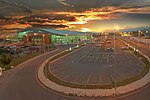
The Poladi stadium is a multi-use stadium in Rustavi, Georgia. Used mostly for football matches, the arena belonged to the local municipality before it was handed over to the Rustavi metallurgical plant. Therefore, the stadium built in 1948 was the home ground of Metalurgi Rustavi for many years. After the latter dissolved in 2015, FC Rustavi became its tenants, although due to a dispute with the plant administration, at some point they had to move out of the stadium. In early 2018, the Football Federation revealed that talks were ongoing about a possible return of the stadium to the city municipality. The transfer of ownership was announced in October 2018. Since 2023, Liga 3 side FC Rustavi as well as their junior team participating in the regional league have been using the stadium for home matches. The stadium is able to hold 4,657 people. Original capacity before installing individual seats was 10,720. Twice, in 1985 and 2009, the arena underwent a partial reconstruction.

Excerpt from the Wikipedia article Poladi Stadium (License: CC BY-SA 3.0, Authors, Images).

Poladi Stadium
Mshenebelta Street, Rustavi Old Rustavi

Geographical coordinates (GPS) Address Nearby Places
placeShow on map

Wikipedia: Poladi StadiumContinue reading on Wikipedia

Geographical coordinates (GPS)

Latitude Longitude
N 41.541 ° E 45.006944444444 °
placeShow on map

Address

Mshenebelta Street
3700 Rustavi, Old Rustavi
Lower Kartli, Georgia
mapOpen on Google Maps

Poladi Stadium
Poladi Stadium
Share experience

Nearby Places

Battle of Krtsanisi
Battle of Krtsanisi

The Battle of Krtsanisi (Georgian: კრწანისის ბრძოლა, romanized: k'rts'anisis brdzola, Persian: نبرد کرتسانیسی) was fought between the army of Qajar Iran (Persia) and the Georgian armies of the Kingdom of Kartli-Kakheti and Kingdom of Imereti at the place of Krtsanisi near Tbilisi, Georgia, from September 8 to September 11, 1795, as part of Agha Mohammad Khan Qajar's war in response to King Heraclius II of Georgia’s alliance with the Russian Empire. The battle resulted in the decisive defeat of the Georgians, capture, and complete destruction of their capital Tbilisi, as well as the temporary absorption of eastern parts of Georgia into the Iranian empire.Although the Russian Empire had officially declared in the Treaty of Georgievsk of 1783 that it would protect Heraclius's kingdom against any new Iranian attempts to re-subjugate Georgia, Russia did not intervene to protect its ally. Subsequently, in order to restore Russian prestige, Catherine the Great launched a punitive campaign against Iran in 1796, but it was soon recalled after Catherine's death the same year. The reestablishment of Iranian rule over Georgia did not last long, for the shah was assassinated in 1797 in Shusha, and the Georgian king died the year after. With Georgia laying in ruins and the central authorities in Iran occupied with the question of succession, the way was opened for Georgia's annexation by Russia several years later by Tsar Paul. As Iran could not allow the cession of Transcaucasia and Dagestan, which were integral parts of Iran for centuries, the Battle of Krtsanisi directly led to two bitter Russo-Persian wars in 1804–1813 and 1826–1828, in which Fath Ali Shah, Agha Mohammad Khan's successor, unsuccessfully attempted to reverse Russian military advances and restore Iranian authority north of the Aras and Kura rivers. After these wars, Iran ceded Transcaucasia and Dagestan to imperial Russia per the Treaty of Gulistan (1813) and the Treaty of Turkmenchay (1828).